The price of accepting a payment is often reduced to a transaction fee, but the real economics can extend further. Who pays the fee, how much work the system creates, when funds become available, and how smoothly payments fit into daily operations can shape the true cost of getting paid.
EXECUTIVE SUMMARY
When retailers compare payment solutions, pricing is usually one of the first topics they discuss.
That makes sense. Every business should understand what it pays and what it receives in return.
The problem is that payment economics is often reduced to a single number.
A transaction fee or processing rate may be easy to compare, but it does not necessarily capture the full economic impact of a payment system.
Different payment models can distribute costs differently. Some expenses may fall directly on the merchant. Others may be structured between the customer, merchant, and payment provider.
Other costs never appear on a processing statement at all.
Employee time spent reconciling transactions costs money. Delayed or unpredictable access to funds can affect working capital. Disconnected systems can create additional administrative work. Checkout friction can consume employee time and shape the customer experience. Retailers should see these costs as part of the total cost to accept, because they affect both operations and cash flow.
Evaluating payments requires a broader framework.
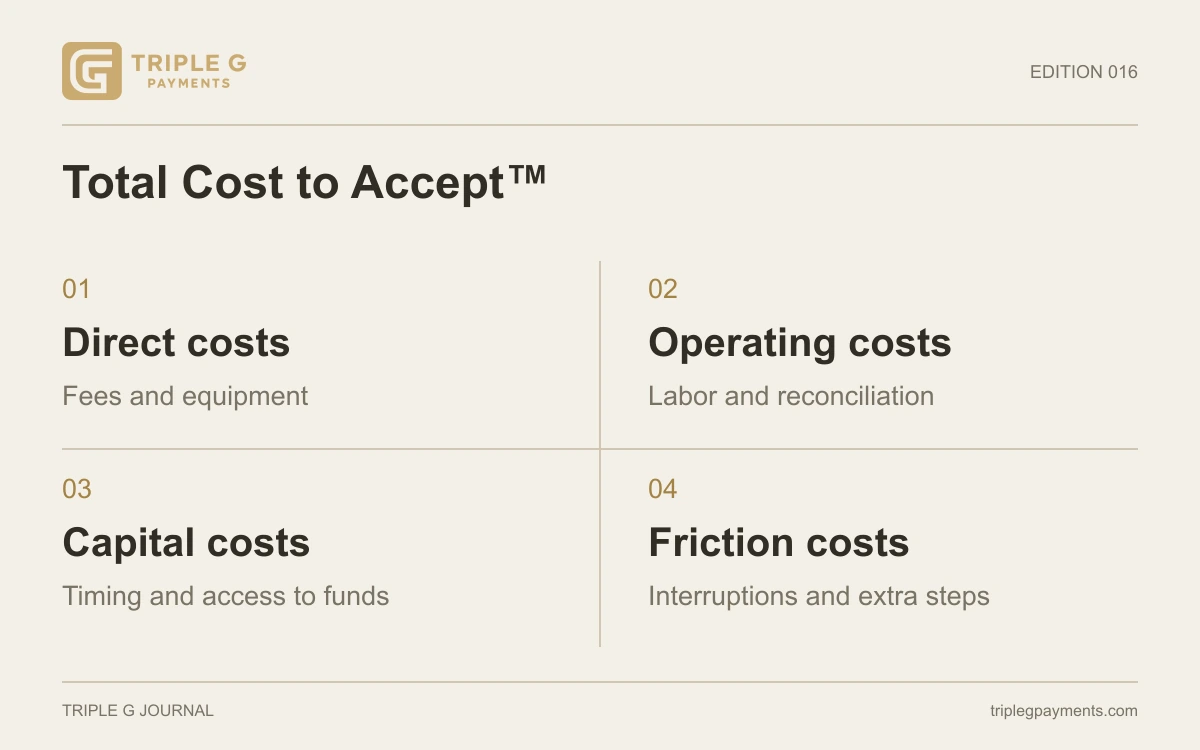
Triple G Journal calls this the Total Cost to Accept™.
DIRECT COSTS + OPERATING COSTS + CAPITAL COSTS + FRICTION COSTS = TOTAL COST TO ACCEPT™
The framework’s purpose is simple: help retailers evaluate the full economic impact of a payment model and identify what it means for their business, rather than focusing on a single visible fee.
THE RATE IS ONLY ONE NUMBER
Payment pricing is an attractive comparison tool because it appears objective.
One provider charges one amount. Others charge something different.
But even before comparing those numbers, retailers should ask a more fundamental question:
Who actually pays for it?
Payment models are not always structured in the same way.
Depending on the program, merchants may pay transaction-related costs, pass them to customers, incorporate them elsewhere in the payment experience, or split them among different participants.
That means two programs with similar transaction economics can create very different outcomes for the retailer.
The rate matters.
The structure around the rate matters too.
Understanding that distinction is the starting point for understanding the Total Cost to Accept™.
THE TOTAL COST TO ACCEPT™
The Total Cost to Accept™ framework divides payment economics into four categories:
- Direct Costs
- Operating Costs
- Capital Costs
- Friction Costs
Not every retailer will experience these costs in the same way.
The framework is not intended to produce one universal number for the entire industry. It is designed to give operators a more complete set of questions when evaluating how payments affect their businesses and what they should look for.
1. DIRECT COSTS
Direct costs are the easiest part of the payment system to identify.
Depending on the provider and payment model, they could include transaction charges, processing expenses, equipment costs, software fees, service fees, or other contractual expenses.
These are the numbers retailers can usually see.
But identifying a fee is only the beginning.
Retailers should understand:
Who pays for it?
When is it charged?
Is it fixed or transaction-based?
Does it change with volume?
Are there equipment or software expenses?
Are there additional contractual costs?
What does the merchant receive economically from each transaction?
These questions matter most when comparing fundamentally different payment models.
A merchant-paid processing structure should not automatically be evaluated in the same way as a model in which transaction economics are distributed differently.
The objective should be to understand the net economic effect on the retailer, not simply the most visible number, so retailers can judge what it means for their operation.
2. OPERATING COSTS
Some of the most important payment costs never appear on an invoice.
They appear in time.
Imagine a retailer processing transactions throughout the day, receiving funding later, reviewing reports from multiple systems, and then having employees manually determine whether everything matches.
No individual step may seem significant.
Repeated every day across hundreds or thousands of transactions, those steps become part of the operating cost of accepting payments.
The same applies when employees must investigate discrepancies, switch between platforms, contact support, troubleshoot equipment, or manually transfer information between systems.
The payment system consumes labor.
That labor has value.
This becomes increasingly important as retailers grow.
One store may tolerate an inefficient process because an experienced manager understands how everything fits together.
Five, ten, or twenty locations create a different challenge.
Small inefficiencies begin multiplying across stores, managers, accounting teams, and transaction volume.
A payment system should therefore be evaluated partly by how much work it creates after the customer leaves.
3. CAPITAL COSTS
A successful transaction and accessible capital are not necessarily the same event.
That distinction matters.
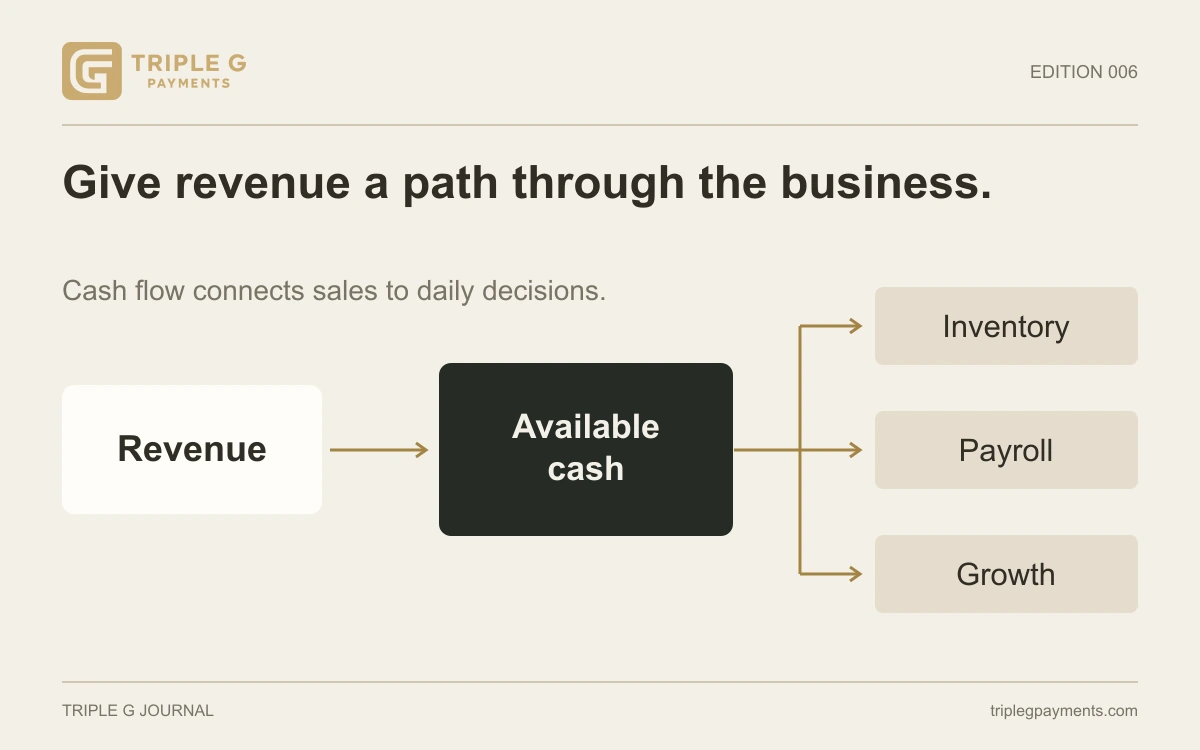
Retailers have inventory to purchase, employees to pay, facilities to operate, taxes to manage, and growth opportunities to fund.
The predictability of incoming cash influences those decisions.
That is why retailers should evaluate funding as part of payment economics.
The question is not simply:
“How quickly do I get paid?”
Retailers should also understand the consistency and visibility of the funding process.
Can the business clearly connect transaction activity to settlement?
Can management anticipate when funds should become available?
Can accounting teams reconcile deposits with the activity that produced them?
Are exceptions easy to identify?
Predictability can be just as important as speed.
A fast-funding process that is difficult to understand can still create administrative complexity.
A transparent process gives management greater visibility into how money moves through the business.
That visibility becomes more valuable as transaction volume increases.
4. FRICTION COSTS
Friction is difficult to see on a financial statement, but retailers experience it every day.
It appears whenever a process requires more effort than necessary.
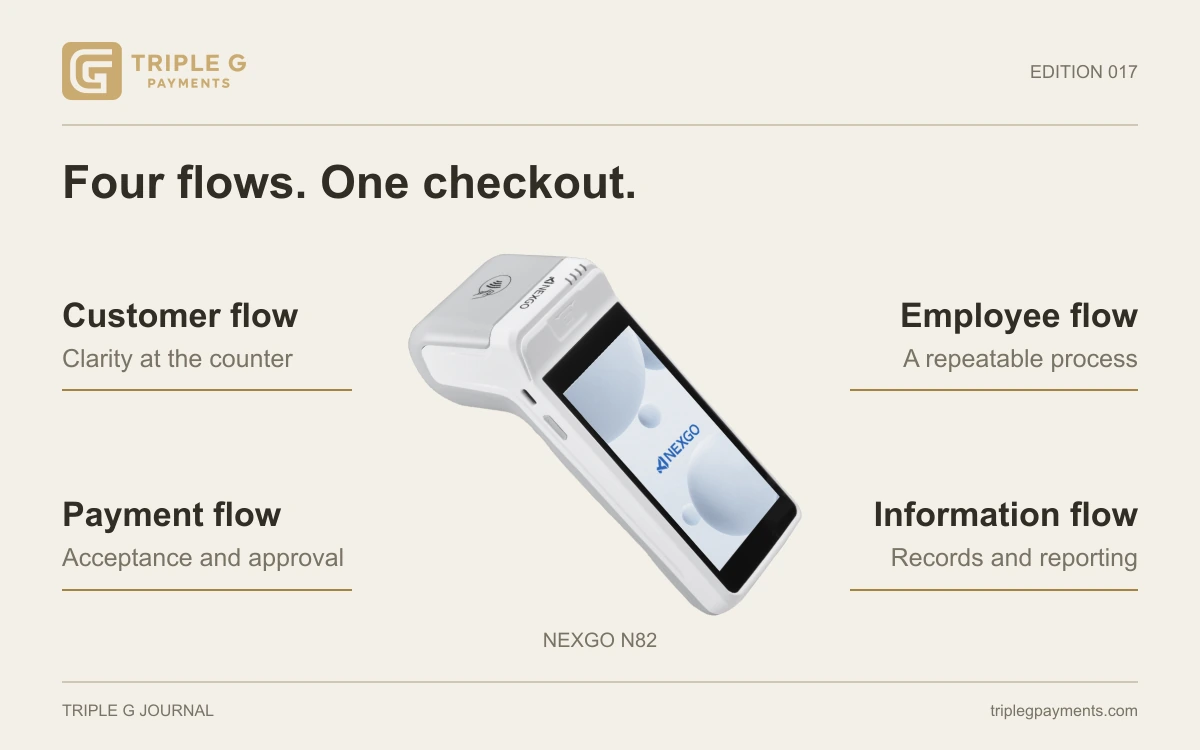
At checkout, friction could mean extra steps for customers or employees.
Behind the counter, it could mean training staff in unnecessarily complicated procedures.
In the back office, it could mean manually comparing systems that do not communicate clearly.
At the management level, it could mean spending time trying to understand where money is, when it arrives, or why reports do not align.
Each moment may seem small.
Together, they affect operational efficiency.
This is why payment economics cannot be separated from payment experience.
A system that looks inexpensive on paper but repeatedly creates extra work may carry costs measured elsewhere.
THE ECONOMICS CAN WORK BOTH WAYS
Retailers should also look beyond the traditional idea of payment costs.
Payments don’t have to be an expense.
Depending on a payment program’s structure, transaction economics can be distributed differently between the customer and merchant.
Some models may shift certain transaction costs away from the retailer.
Other structures may allow the merchant to participate economically in transaction activity.
That fundamentally changes how the payment system should be evaluated.
Instead of treating payments solely as a cost center, retailers can examine the program’s net economic impact.
That does not mean every alternative structure is automatically better.
Customer experience still matters.
Operational reliability still matters.
Funding still matters.
Reporting still matters.
Support still matters.
The point is that retailers should evaluate payment economics as a complete system.
FROM GROSS COST TO NET ECONOMIC IMPACT
This leads to an important distinction.
Gross payment cost asks:
“What fees exist?”
Net economic impact asks:
“After considering costs, merchant economics, operational workload, funding, and friction, what does this payment model actually mean for the business?”
The second question provides a much more complete picture.
A program with a lower advertised rate could still create more manual work.
A program with inexpensive hardware could still create checkout friction.
A program with attractive transaction pricing could still make reconciliation difficult.
Conversely, a differently structured payment model could change who bears transaction costs or create economic participation for the retailer.
The visible price and the economic outcome are not always the same thing.
SCALE MAGNIFIES PAYMENT ECONOMICS
Payment economics matters even more as a retailer grows.
At low transaction volume, small workflow differences may be manageable.
At higher volume, repetition magnifies them.
A few additional seconds at checkout can add up to hours of cumulative employee time.
A reconciliation process performed manually at one location may become a significant accounting workflow across multiple stores.
Small differences in funding visibility matter more as daily transaction volume and working capital requirements increase.
Scale does not simply increase revenue. It increases the consequences of system design.
And those consequences shape the total cost to accept.
This is why growing retailers should evaluate payments as infrastructure rather than merely as another vendor's expense.
QUESTIONS RETAILERS SHOULD BE ASKING
Before evaluating a payment provider solely by rate, operators should understand the larger economics surrounding the program.
Who pays transaction-related costs?
What expenses fall directly on the merchant?
What equipment or software costs exist?
Does the merchant participate economically in transaction activity?
How predictable is funding?
How easily can deposits be connected to transaction activity?
How much manual reconciliation does the system require?
How much employee training and intervention does a checkout require?
What happens operationally when something goes wrong?
These questions reveal much more about the true cost of accepting payments than a single percentage or transaction fee.
BUILDING ON THE PAYMENTS STACK
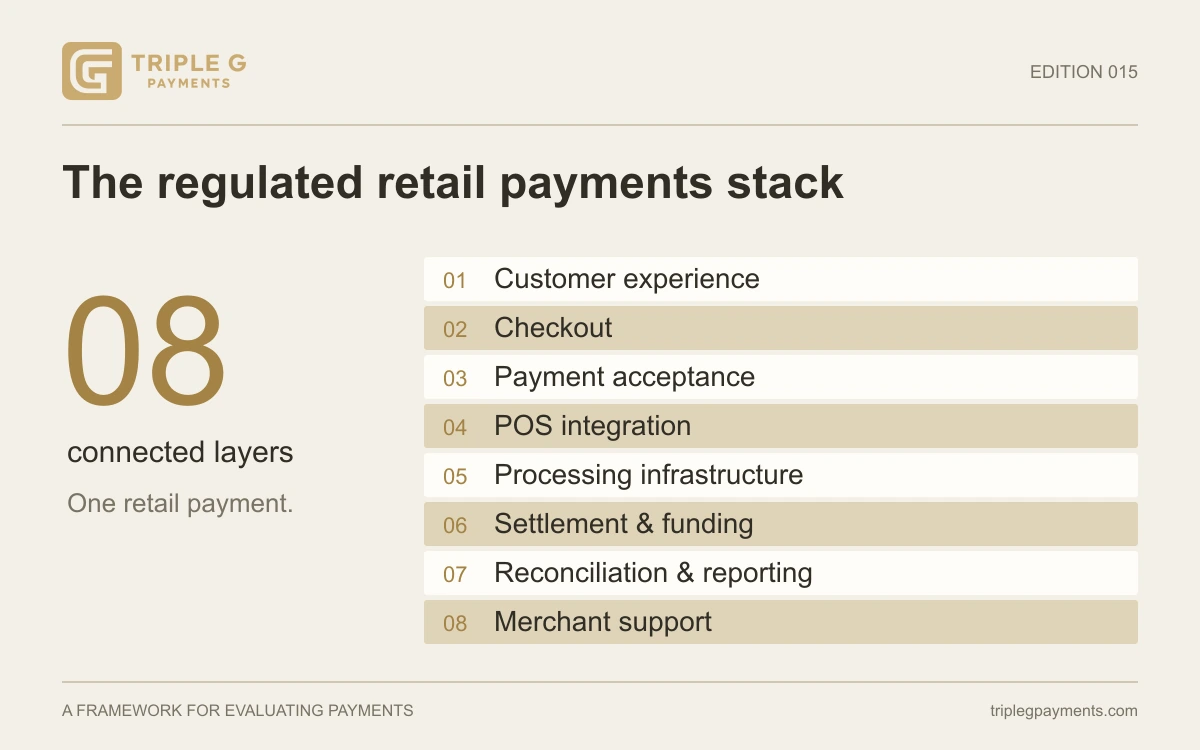
Edition 015 introduced the Regulated Retail Payments Stack, which examines the infrastructure supporting a transaction.
The Total Cost to Accept™ adds another dimension.
The Payments Stack asks:
What systems make the transaction possible?
The Total Cost to Accept™ asks:
What economic impact does operating those systems create?
Together, these frameworks help retailers examine payments from both an infrastructure and economic perspective.
That distinction will matter more as regulated retail operations become more sophisticated.
THE BIGGER PICTURE
Getting paid is not a single event.
It is a system.
A customer initiates a transaction. Technology accepts it. Infrastructure processes it. Funds move. Reports are generated. Employees reconcile activity. Management uses the resulting capital to operate the business.
Economics exist throughout that entire process.
Some are obvious.
Others hide in time, complexity, funding, or friction.
Retailers that understand the complete system are better positioned to evaluate what their payment infrastructure is actually doing for the business.
The goal shouldn’t be finding the smallest number on a pricing sheet.
The goal should be understanding the total economic outcome.
THE TRIPLE G PERSPECTIVE
Payments are operating infrastructure.
Understanding their true cost requires looking beyond the transaction rate and examining the complete system surrounding the payment.
Who pays?
How much work does the system create?
How predictably does money move?
How much friction exists between the customer, employee, payment system, and back office?
Does the payment model operate exclusively as an expense, or does its structure create different economics for the retailer?
Those questions provide a more complete view of what it actually costs to get paid.
The lowest visible price does not automatically produce the lowest total operating cost.
Sometimes the more important opportunity is changing the economics of accepting payments altogether.
Moving Cannabis Commerce Forward.
- Cannabis
- Payment Processing
- Payment Economics
- Retail Operations
- Cash Flow
- Merchant Funding
- Reconciliation
- Total Cost to Accept
Review your current payment program
Put this article to work. Request a payment review and we will evaluate your current rebate, operating fees, transaction volume, and equipment needs.
Request a Payment Review
Triple G Journal publishes educational content for cannabis retail leaders, covering cannabis payments, retail operations, finance, technology, compliance, leadership, and business strategy. Every edition is written and reviewed by the Triple G Payments team.