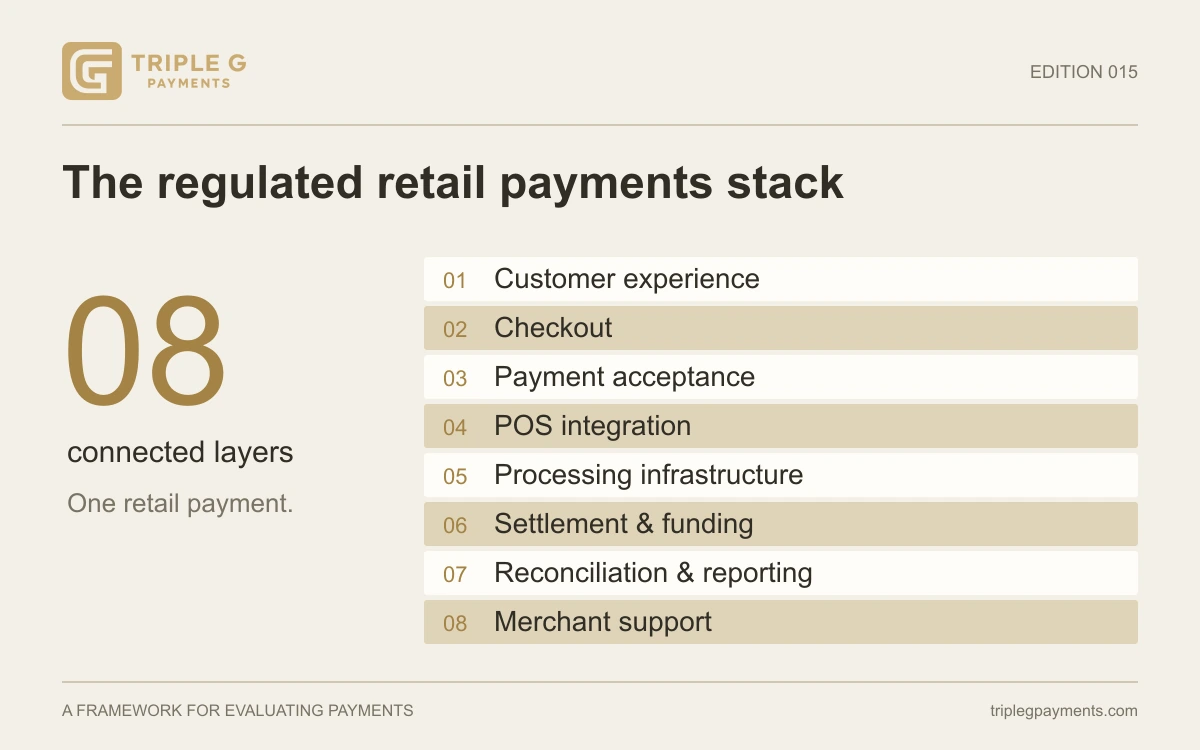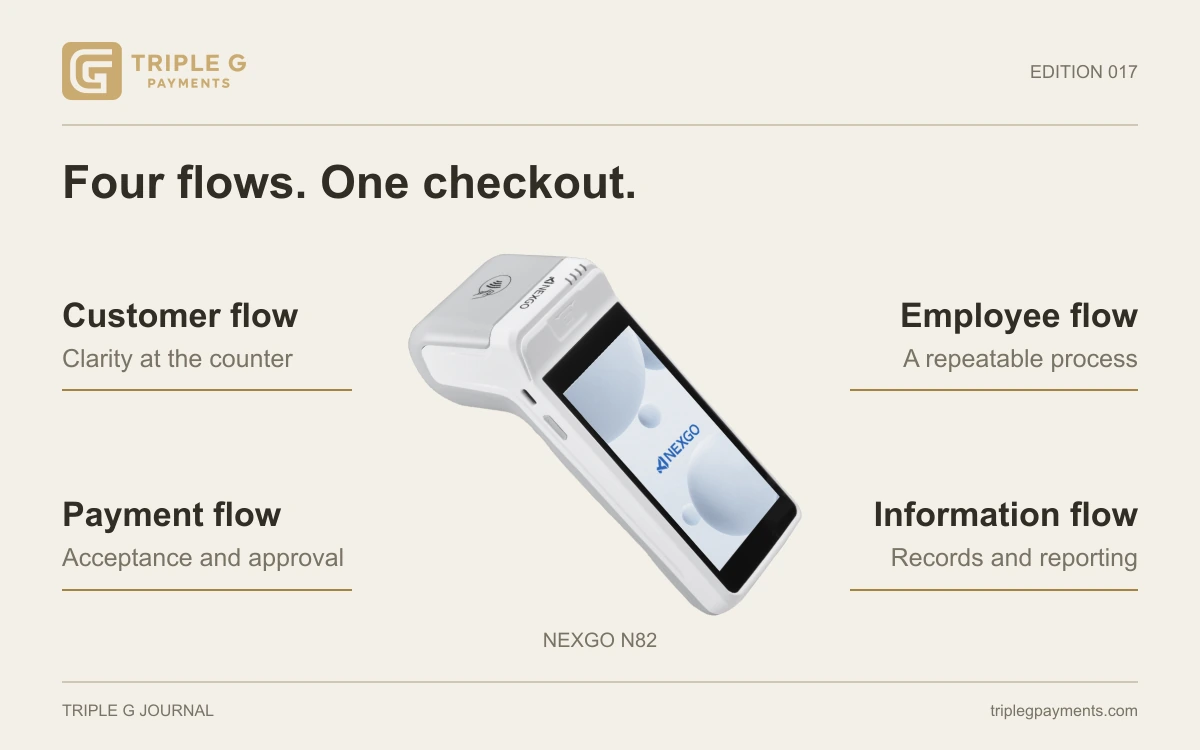
For the customer, a payment may take only a few seconds. For the retailer, that transaction continues through settlement, funding, reporting, and reconciliation. Looking at the full lifecycle gives operators a clearer picture of how payments interact with their business.
Executive Summary
At the checkout counter, payments appear simple.
A customer makes a purchase. The transaction is approved. The sale is complete.
From the customer’s perspective, the process is over.
From the retailer’s perspective, much more happens behind that moment.
Every completed transaction becomes part of a larger financial and operational process. It must move through the appropriate payment infrastructure. Activity has to be recorded. Funds need to move according to expected timelines. Reporting needs to accurately represent what happened at the store. Eventually, the retailer has to reconcile that activity against its own records.
These steps rarely get the same attention as the checkout experience because most happen outside the customer’s view.
But being invisible does not make these steps unimportant.
For a retailer processing meaningful transaction volume, small inconsistencies across settlement, funding, reporting, or reconciliation can create additional work for managers, accounting teams, and ownership.
Understanding payments therefore requires looking beyond the moment of authorization. It requires understanding the entire payment lifecycle.
The Payment Experience Has Two Sides
The customer experiences only a small portion of payment infrastructure.
They approach the counter, select a payment method, follow a few prompts, complete the transaction, and receive confirmation.
That experience matters.
Checkouts should feel intuitive. Employees should understand the process. Technology should work reliably. Customers shouldn’t need to understand the infrastructure behind the transaction to make a purchase.
But the retailer experiences another side of the same transaction.
After the customer leaves, the business still needs to know what happened financially.
Was the transaction recorded correctly?
When should the funds become available?
Does the payment activity correspond with the store’s reporting?
Can management clearly identify discrepancies?
Can accounting reconcile the activity efficiently?
These questions belong to the same transaction the customer considered finished seconds earlier.
That difference between the customer payment experience and the merchant payment lifecycle matters because one is visible, and the other runs underneath the business.
The Triple G Payment Lifecycle
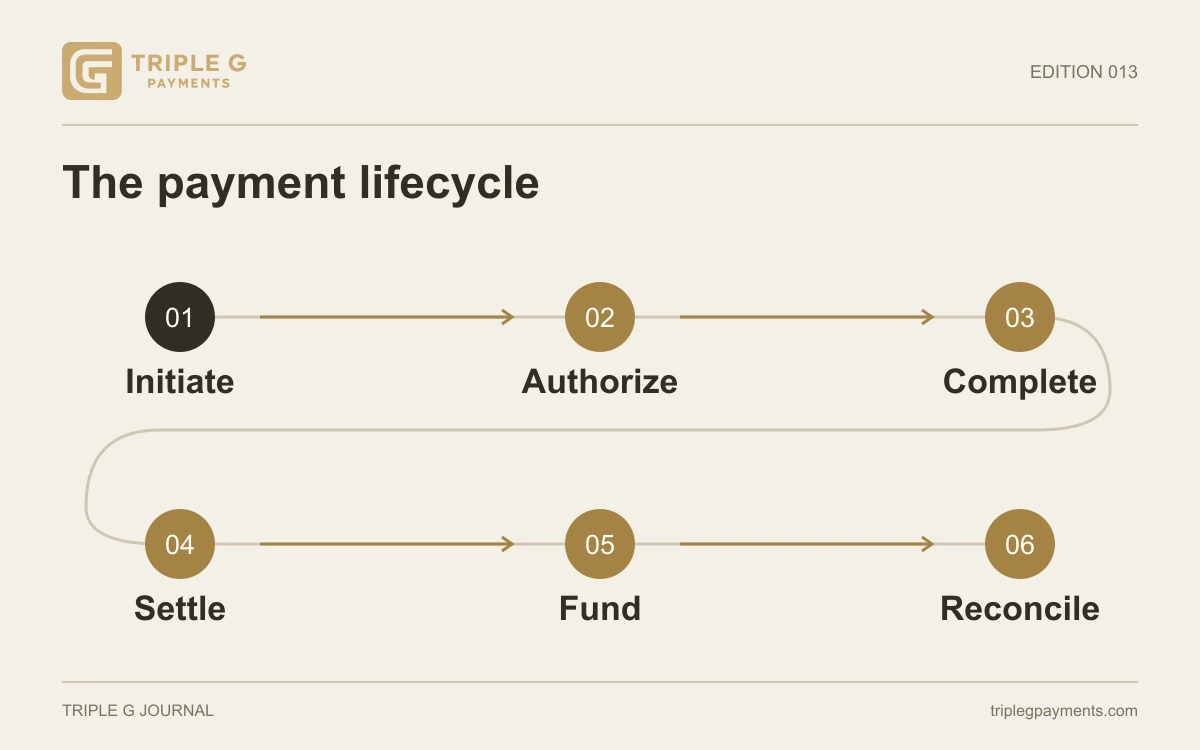
A useful way to understand this infrastructure is to break the transaction into six stages:
Initiate → Authorize → Complete → Settle → Fund → Reconcile
Each stage represents a different part of the transaction journey.
Together, they create what we call the Triple G Payment Lifecycle. The framework is intentionally simple. Operators should not need to become payment engineers to understand how payments affect their business. Still, they should understand what each stage does and where operational friction can emerge.
1. Initiate
Every transaction begins when the customer chooses to make a purchase and initiates payment.
At this stage, the retailer’s payment environment intersects directly with the customer experience.
The physical checkout layout matters.
The available payment options matter.
The employee’s understanding of the process matters.
The payment device and POS workflow matter.
A confusing process can create unnecessary questions or delays before the transaction has even begun moving through the payment infrastructure.
For retailers processing hundreds of transactions throughout the week, even minor friction can compound.
Initiation is therefore not simply a technical event.
It is part of the retail experience.
2. Authorize
Once payment information is submitted, the transaction needs to receive the appropriate authorization.
From the customer’s perspective, this is often reduced to a simple outcome:
Approved or declined.
For the retailer, the issue is broader. A store may have strong inventory, trained employees, consistent customer traffic, and a well-designed retail environment. Still, none of those strengths eliminate the disruption created when customers cannot reliably complete purchases.
Authorization is one reason payment infrastructure should be evaluated as operational infrastructure rather than simply financial technology.
The ability to accept a transaction sits directly inside the retailer’s revenue-generating process.
3. Complete
Authorization alone does not necessarily mark the end of the retail workflow.
The transaction must be completed correctly within the retailer’s systems.
That may include communication between the payment environment, POS, receipt process, tipping workflow, employee procedures, and internal reporting.
This is where system design begins to matter.
When technology and employee workflows operate cohesively, checkouts can remain relatively simple.
When they don't, employees may need extra steps, manual processes, or workarounds.
Those workarounds may appear manageable at low transaction volume.
At scale, they become operational friction.
The strongest checkout environments make the completed transaction clear to both the customer and the business.
4. Settle
Once the customer-facing portion is complete, the transaction enters a less visible stage.
Settlement is the stage in which completed transaction activity is finalized within the relevant payment infrastructure before funding occurs. At this point, operators should understand how settlement fits between authorization and available funds, and what normal timing looks like.
For operators, technical mechanics may be less important than operational expectations.
Leadership should understand how its payment activity progresses after checkout, what normal settlement behavior looks like, and how that stage connects to funding and reconciliation.
When expectations are unclear, ordinary timing can sometimes look like a problem. A retailer does not need to monitor every technical movement behind every transaction, but it does need enough understanding to recognize whether payment activity is behaving as expected.
5. Fund
Eventually, transaction activity must become available funds for the merchant under the applicable payment arrangement and schedule, following settlement. This is where funding timing starts to matter operationally.
This connects payments directly to cash flow.
Inventory purchases, payroll, vendors, operating expenses, taxes, and expansion plans all depend on financial resources moving through the business.
For that reason, operators should understand their funding expectations and how those expectations affect cash flow.
When are funds generally expected?
How do weekends or other timing factors affect availability?
Where can funding activity be reviewed?
Predictability becomes particularly valuable as transaction volume grows because the issue is not simply how quickly money moves.
The business needs to understand how reliably it can plan that movement.
That distinction matters.
6. Reconcile
The final stage is one of the easiest to overlook.
The business needs to reconcile payment activity against its own financial and operational records after funding and reporting are complete.
Transactions occurred at the store.
The POS recorded sales.
Payment systems recorded activity.
Funds eventually moved.
When those records align, reconciliation can become a routine financial process. When they do not, someone has to determine why.
That may require comparing transaction records, store reports, funding information, or accounting records.
At low volume, a manual investigation may feel like a minor inconvenience.
Across substantial transaction volume or multiple locations, repeated reconciliation friction can compound. That is why reporting isn't merely a back-office feature. Good reporting turns payment activity into clear business information.
The Back Half Of The Transaction Deserves More Attention
Most conversations about payments naturally begin at checkout.
Will customers use it?
How does the terminal work?
What does the transaction cost?
How quickly can employees learn the process?
These questions primarily address the front half of the payment lifecycle, while the back half deserves its own evaluation.
Settlement determines how completed activity progresses toward funding.
Funding determines when that activity becomes available financial resources.
Reporting creates visibility across the activity as it moves through the lifecycle. It helps operators understand settlement timing, funding movement, and reconciliation outcomes, making the later stages of the payment lifecycle easier to manage.
Reconciliation determines how efficiently the business can account for what occurred across those stages.
Support becomes important when any of those stages do not behave as expected. As the payment lifecycle progresses, each later stage can create questions that require timely support.
A payment solution can therefore create friction even when the checkout experience appears perfectly functional.
That is why you should evaluate payment performance across the entire lifecycle.
Why Small Payment Friction Becomes Larger at Volume
The importance of the payment lifecycle increases with scale because small issues become more costly as volume grows.
Consider a minor reporting issue that requires only a few minutes of management attention.
For one transaction, it is insignificant.
Repeated across multiple days, employees, systems, or locations, the cost changes.
The same principle applies to manual reconciliation.
Funding uncertainty.
Employee workarounds.
Disconnected reporting.
Support delays.
Small operational problems rarely remain small when volume multiplies them.
This matters most for growing cannabis retailers.
A single store may compensate for imperfect processes through experienced managers and direct owner involvement.
A multi-location operator cannot depend indefinitely on individual employees remembering how to resolve every exception.
Infrastructure has to carry more of the responsibility.
Payments are part of that infrastructure.
A Better Way To Evaluate Payments
Retailers evaluating payment infrastructure should certainly understand pricing, hardware, customer experience, and acceptance.
But the evaluation should continue further.
Operators should understand the transaction from initiation through reconciliation.
What happens when the customer begins paying?
What happens when the transaction is authorized?
How does it interact with checkout?
What happens after the customer leaves?
When should funds become available?
How can activity be reviewed?
How efficiently can it be reconciled?
What happens when something does not match expectations?
These questions provide a more complete view of payment infrastructure than focusing on a single fee or device.
They also help operators identify where payment decisions intersect with other parts of the business.
The Bigger Picture
Payments sit at an unusual intersection inside retail.
They touch the customer experience.
They touch employees.
They interact with technology.
They influence financial operations.
They generate data.
They affect cash movement.
They eventually reach accounting and reconciliation.
That makes payments much more than the few seconds a customer spends completing a purchase.
The transaction at the counter is simply the most visible part of a much larger system.
Understanding that system gives operators a stronger foundation for evaluating the technology and partners that support it.
The Triple G Perspective
The best payment infrastructure often becomes less visible when it is working properly.
Customers complete purchases without thinking about what happens next.
Employees move through checkout without unnecessary workarounds.
Managers understand what occurred.
Leadership knows what to expect from funding.
Accounting can reconcile activity without turning every discrepancy into an investigation.
Creating that experience requires looking beyond whether a transaction can be accepted.
It requires understanding the complete journey:
Initiate → Authorize → Complete → Settle → Fund → Reconcile
For modern cannabis retailers, every stage matters.
Because the moment a customer completes a purchase may feel like the end of the transaction.
For the business, it is only the beginning.
Review your current payment program
Put this article to work. Request a payment review and we will evaluate your current rebate, operating fees, transaction volume, and equipment needs.
Request a Payment Review
Triple G Journal publishes educational content for cannabis retail leaders, covering cannabis payments, retail operations, finance, technology, compliance, leadership, and business strategy. Every edition is written and reviewed by the Triple G Payments team.