A completed sale is only one moment in a longer financial process. Understanding settlement, funding, reporting, and reconciliation helps cannabis retailers see how transaction activity becomes usable, accountable business funds and why that matters to the business.
Executive Summary
At the checkout counter, the end of a transaction is easy to recognize.
The payment is approved. The sale is complete. The customer leaves.
Behind the counter, the financial process continues. Transaction activity still needs to progress through the applicable payment infrastructure. As it moves through settlement, funds become available according to the merchant’s arrangement and funding schedule. Reporting provides visibility into what occurred, and those records eventually need to align with the retailer’s internal financial information.
For operators, the technical details behind every money movement are not necessarily the priority.
Visibility and predictability are.
Leadership should understand what happens after transactions are completed, when funds are generally expected to become available, where to review transaction and funding information, and how discrepancies are identified so the business can stay predictable and operate with clearer expectations.
These questions become more important as transaction volume grows.
A single location may be able to investigate an occasional discrepancy manually. As volume grows, however, a retailer operating multiple stores needs a process they can understand and repeat, so issues are easier to manage.
The customer may experience payments in seconds. For the business, however, they unfold over a much longer financial process.
The Sale And The Money Are Connected, But They Are Not The Same Event
When a retailer records a sale, the business has generated revenue.
That does not necessarily mean the corresponding funds are immediately available for the business to use.
This distinction matters.
A store may complete hundreds of transactions throughout the day while also managing inventory purchases, payroll, vendor obligations, operating expenses, taxes, and other financial commitments.
Those responsibilities occur on their own schedules.
Payment activity does too.
Operators therefore benefit from understanding both sides of the equation:
What did the business sell?
And:
When should the resulting funds become available?
The more visibility there is between those two events, the easier it becomes for leadership to understand the operation's financial position and make informed decisions with greater confidence.
Settlement Begins After Checkout
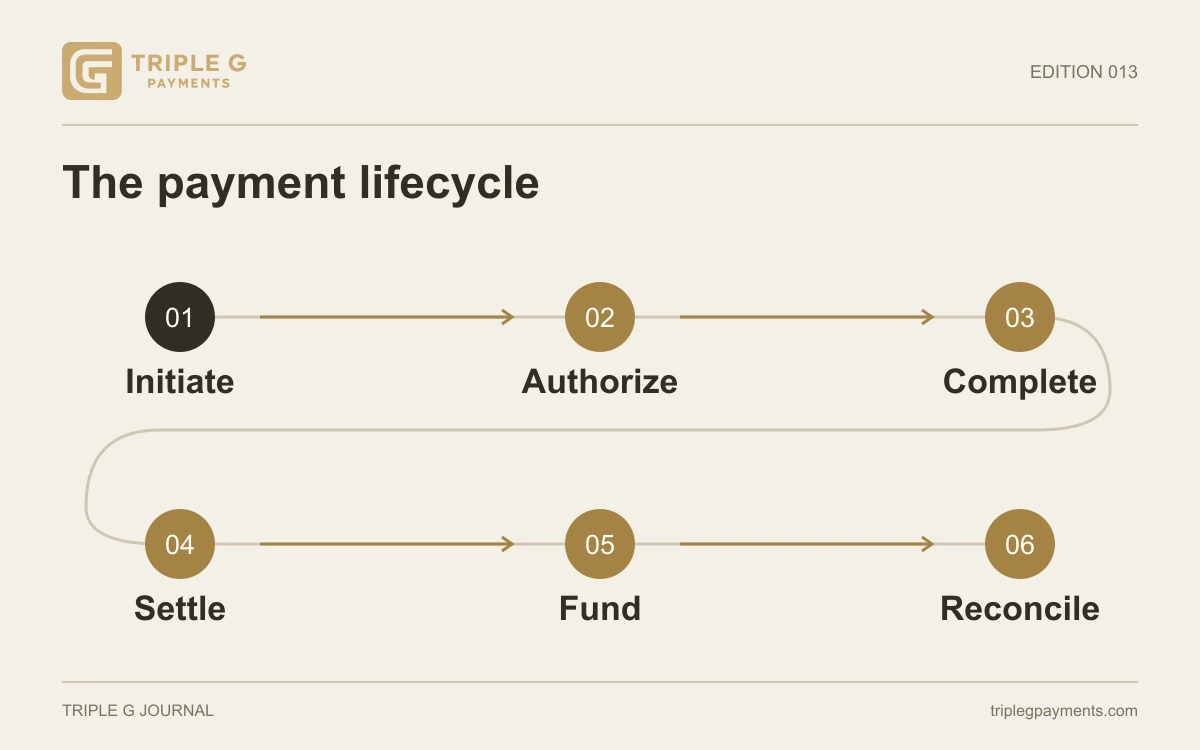
Edition 013 introduced the Triple G Payment Lifecycle:
Initiate → Authorize → Complete → Settle → Fund → Reconcile
Settlement begins in the portion of that lifecycle customers rarely see.
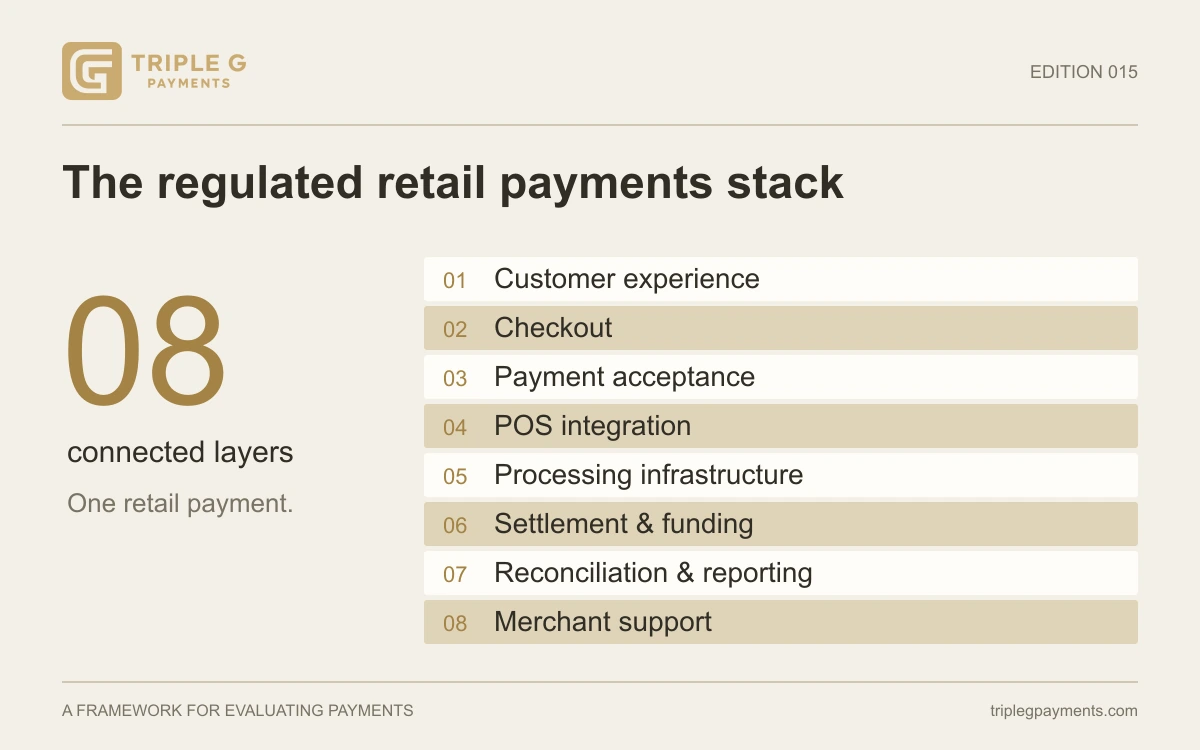
Once a transaction is complete, the associated activity moves through the applicable payment infrastructure before merchant funding occurs. As the activity moves through that process, the exact mechanics vary by payment method, provider, financial institutions, and other elements of the payment arrangement.
Retail operators do not need to become experts in every technical layer involved. They do need to understand what normal looks like, so they can recognize funding activity that needs attention.
When does completed activity typically progress toward funding?
Where can management review that activity?
How are exceptions communicated?
What information is available when something does not appear as expected?
Clear expectations reduce uncertainty and make actual problems easier to recognize, helping operators know what needs attention and when to act.
Funding Turns Payment Activity Into Available Capital
Funding is where payment infrastructure intersects directly with the retailer’s broader financial operation. At this stage, transaction activity results in funds becoming available to the merchant according to the applicable arrangement.
That timing can matter throughout the business.
Cannabis retailers continuously allocate capital.
Inventory needs to be replenished.
Employees need to be paid.
Vendors have payment terms.
Rent and operating expenses have deadlines.
New equipment may need to be purchased.
Expansion may require capital before a new location begins generating meaningful revenue.
Payment funding is therefore not an isolated back-office concept.
It is part of the retailer’s working capital cycle.
The objective should not simply be to ask: How fast do we get paid?
A more useful question is: How predictable is the movement of funds through our business, and what does that predictability tell us about how the business is operating?
Predictability Creates Financial Visibility
Speed attracts attention because it is easy to compare.
Predictability can be more operationally meaningful.
A retailer that understands its expected funding patterns can plan around them.
Management can anticipate when funds should arrive, compare actual activity with expectations, and recognize when something deserves attention. That visibility helps keep the business on track.
That visibility becomes increasingly important as the business grows.
More stores create more transactions.
More transactions create more financial activity.
More financial activity creates more information that needs to be understood.
Without clear expectations, managers may spend time answering questions with straightforward answers.
Did yesterday’s activity fund?
Which transactions are represented in this amount?
Does the amount match what we expected?
Is something missing, or is this normal timing?
A well-understood funding process does not eliminate every exception. It does make exceptions easier to distinguish from normal operations, so teams know when to investigate.
Reporting Connects Transactions To Money Movement
Funding without understandable reporting can still create operational friction. That friction becomes clear when an operator needs to answer questions such as:
How much payment activity occurred yesterday?
Which location generated it?
Which transactions are included?
What amount should the business expect?
What arrived?
Are there differences that require investigation?
Reporting bridges what happened at checkout and what eventually appears in the retailer’s financial records. It gives operators a clearer path from activity to money movement.
That reporting becomes especially important when a retailer operates multiple locations.
An owner overseeing one store may personally understand much of the daily activity.
Leadership overseeing five, ten, or twenty locations cannot rely on memory or individual managers to explain every financial movement.
Information has to be structured.
Payments are part of that structure.
Reconciliation Closes The Loop
A payment lifecycle is not complete simply because funds have arrived.
The business still needs to account for them.
Reconciliation connects payment activity with the records maintained across the operation. Depending on the retailer’s systems and processes, that may involve comparing information from the POS, payment reporting, funding records, bank activity, and accounting systems.
Ideally, those records tell the same story.
When they do, reconciliation becomes a routine financial process that supports control, consistency, and a clearer view of the business.
When they do not, someone needs to determine why.
Perhaps timing explains the difference.
Perhaps a transaction appears in one system differently than expected.
Perhaps activity needs to be associated with a specific location or business day.
The specific causes will vary.
The operational principle does not:
The easier it is to trace financial activity from transaction to funding, the easier it becomes to understand the business, spot issues quickly, and act on them.
Manual Work Becomes More Expensive At Scale
A few minutes of manual investigation may not seem significant.
Scale changes the calculation. Even a few minutes of manual investigation can become meaningful when repeated across locations throughout the year.
Imagine that a manager regularly needs ten minutes to compare reports or investigate funding questions.
At one location, the burden may remain manageable.
Across multiple locations, repeated throughout the year, that same process begins consuming meaningful management time.
The issue is not limited to reconciliation.
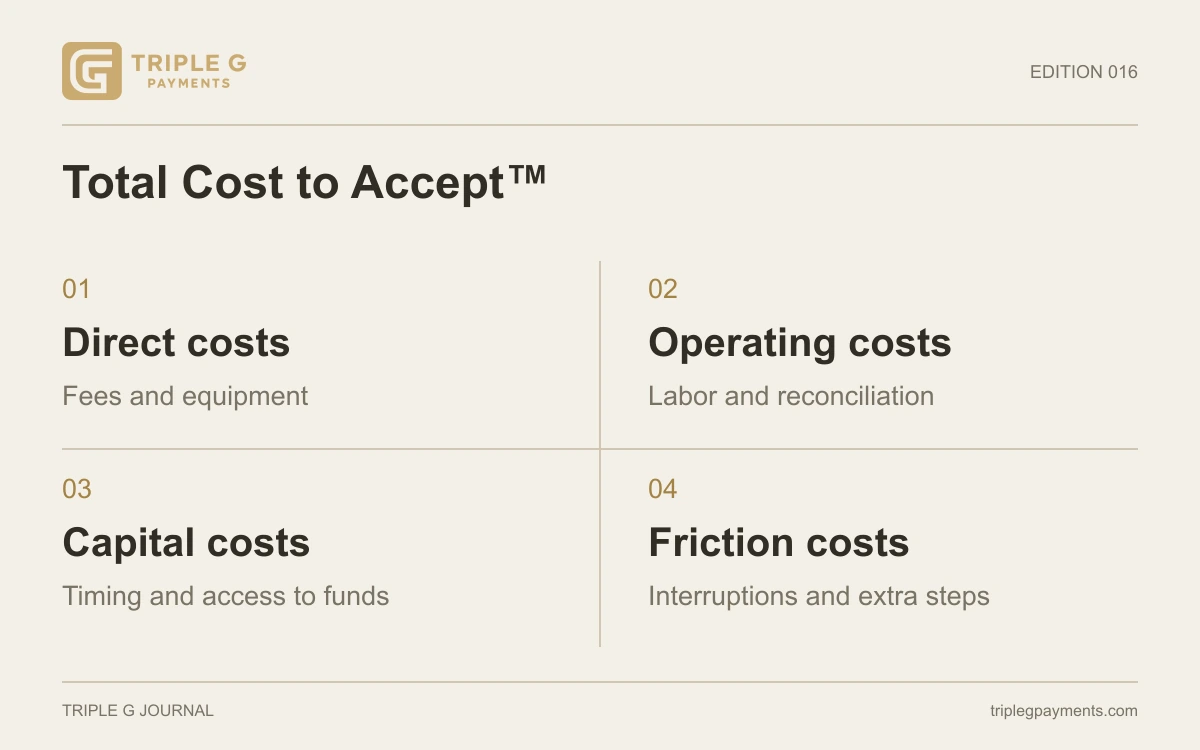
Any recurring payment friction can multiply with transaction volume:
Unclear funding expectations.
Disconnected reporting.
Manual comparisons.
Employee workarounds.
Location-by-location inconsistencies.
Repeated support questions.
These issues may exist quietly while a business is small.
Growth gives them volume.
That is why payment infrastructure that works for one location may need closer evaluation as a retailer expands. The business can then keep visibility as it grows.
Multi-Location Retail Changes The Standard
Multi-location operators face a different challenge from independent stores.
Leadership needs visibility without being physically present at every counter. That requires systems that produce consistent information across locations so the business can stay aligned and informed. As the operation grows, that consistency becomes even more important.
Payment infrastructure contributes to that visibility.
Management may need to understand transaction activity by store, expected funding, reporting consistency, and whether exceptions are isolated or occurring across the organization.
Standardization becomes valuable.
If every location handles payment reporting or reconciliation differently, adding stores can add complexity faster than leadership adds visibility.
The objective is not to eliminate local management.
It is to build infrastructure that lets leadership understand what is happening across the business without manually reconstructing the story.
What Should Retailers Understand About Funding?
Operators do not need technical payments education before choosing infrastructure. They should be able to answer several practical questions.
When is completed transaction activity generally expected to fund?
What factors can affect timing?
Where can transaction and funding information be reviewed?
Can activity be separated by location when necessary?
How does the business connect funding back to the transactions that created it, and what does that connection show about the operation?
What happens when expected activity and actual activity do not align?
Who can help investigate an exception?
What should leadership watch most closely as volume grows?
How do you keep funding, reporting, and reconciliation predictable?
Clear answers to those questions create a much better understanding of the payment relationship than a funding-speed claim by itself.
The Connection To Cash Flow
Edition 012 explored an important distinction:
Revenue and cash flow are related, but they measure different parts of the financial picture.
Payment funding sits directly between those ideas.
A retailer can record strong sales while still needing to understand when the resulting funds become available to support operations.
That makes funding infrastructure part of financial planning.
It does not determine every aspect of cash flow. Inventory strategy, payroll, rent, vendor terms, taxes, debt, capital expenditures, and many other factors also matter.
But payment funding is one component leadership should see clearly.
For high-volume retailers, greater visibility into money movement can support greater visibility into the operation itself.
The Bigger Picture
The payment experience is often judged by what happens in front of the customer.
Was the checkout fast?
Was the transaction approved?
Was the process easy to understand?
Those questions matter.
But the retailer has another experience occurring behind the scenes.
Completed transactions have to become understandable financial activity.
That requires settlement.
Funding.
Reporting.
Reconciliation.
And when something doesn't behave as expected, it needs a clear path to resolution.
The strongest payment infrastructure should help make that process easier to understand as transaction volume and organizational complexity increase.
The Triple G Perspective
A customer may experience a payment for only a few seconds.
The retailer experiences that transaction long after the customer leaves.
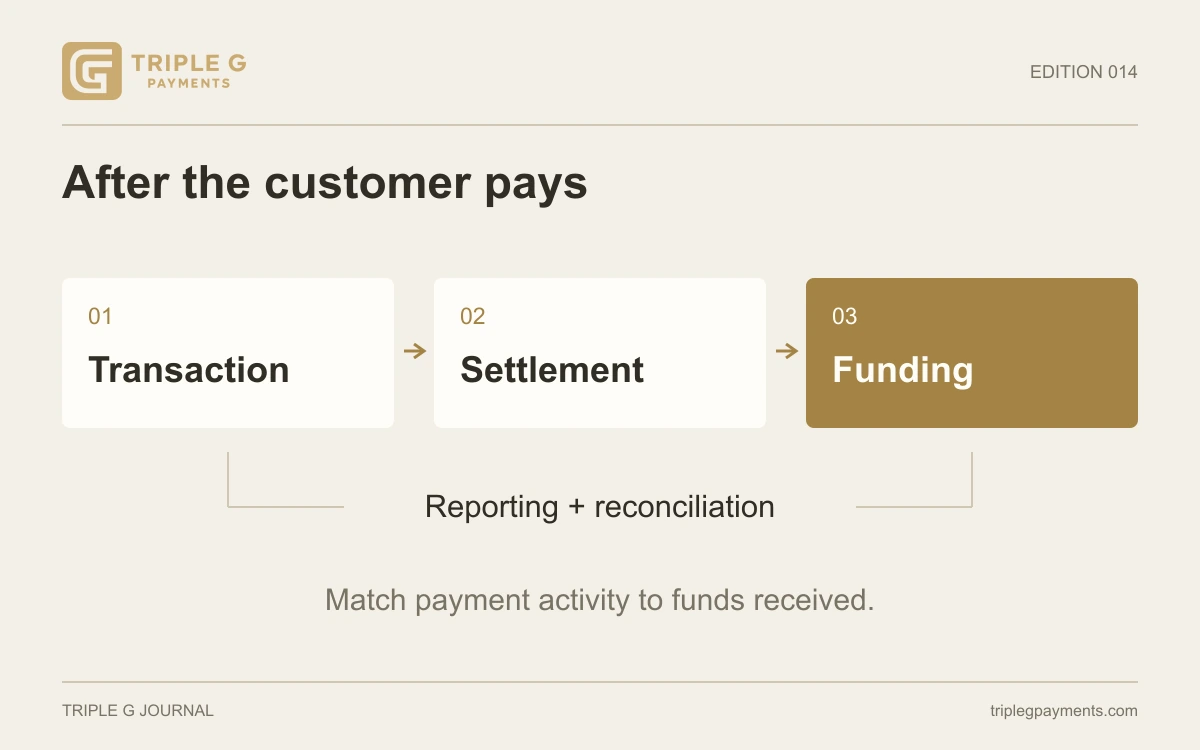
It moves from checkout into settlement.
From settlement into funding.
From funding into reporting.
From reporting into reconciliation.
Each stage connects the transaction more deeply to the business's financial operations.
That is why payment infrastructure should do more than enable a sale.
It should provide enough visibility for operators to understand what happened afterward.
Because receiving payments is important.
Being able to follow that payment through the business is what closes the loop.
Review your current payment program
Put this article to work. Request a payment review and we will evaluate your current rebate, operating fees, transaction volume, and equipment needs.
Request a Payment Review
Triple G Journal publishes educational content for cannabis retail leaders, covering cannabis payments, retail operations, finance, technology, compliance, leadership, and business strategy. Every edition is written and reviewed by the Triple G Payments team.