Checkout may look like the final few seconds of a sale, but for a retailer, it is where customers, employees, payments, technology, and information must work together in real time. The strongest checkout experiences are not defined by one device. They are built as connected operating systems.
EXECUTIVE SUMMARY
A customer approaches the counter, completes a payment, receives their purchase, and leaves.
From the customer’s perspective, checkout may last only a few moments.
From the retailer’s perspective, considerably more is happening.
An employee is navigating the point of sale. Transaction information is being created. A payment is being initiated and authorized. Multiple systems may need to communicate. Records are being generated that will eventually influence settlement, reporting, and reconciliation.
All of this happens around a single moment in the customer journey.
That is why checkout shouldn’t be viewed as simply the final step of a sale.
Checkout is an operating system.
Triple G Journal calls the structure behind that experience the Checkout Architecture.
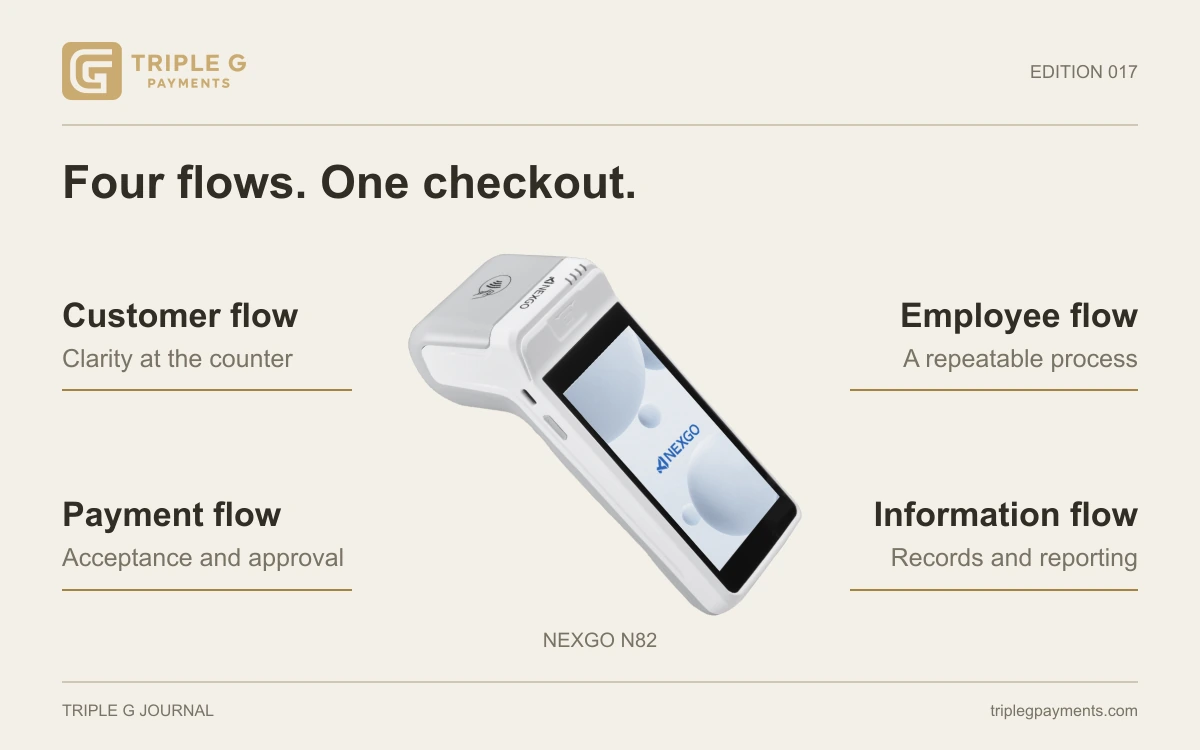
It consists of four connected flows:
CUSTOMER FLOW • EMPLOYEE FLOW • PAYMENT FLOW • INFORMATION FLOW
When those four flows work together, checkout can feel remarkably simple.
When they do not, the counter is often where operational problems become visible first.
THE COUNTER IS WHERE SYSTEMS MEET
Retail operations contain dozens of systems and processes.
Inventory is managed. Employees are trained. Products are organized. Customers are served. Payments are accepted. Transactions are reported. Funds are settled. Accounting teams reconcile activity.
Many of those processes eventually converge at checkout.
That makes the counter an unusually important operating environment.
A problem elsewhere in the business can surface there.
A slow process can cause customer delays.
A disconnected payment system can become additional employee work.
A confusing interface can become a training problem.
Missing or disconnected information can become a reconciliation problem later.
Checkout does not create every operational issue.
It often reveals them.
THE CHECKOUT ARCHITECTURE
The Checkout Architecture provides a framework for understanding the systems surrounding a completed sale.
Rather than evaluating checkout solely by transaction speed or hardware, retailers can examine four flows that need to operate together.
1. CUSTOMER FLOW
Customer flow describes the experience from the moment someone is ready to purchase until the transaction is complete.
The objective is straightforward:
Make the path to payment understandable and efficient.
Customers generally should not need to understand the infrastructure behind the transaction.
They should know what to do next.
That distinction matters.
Every unnecessary decision, explanation, delay, or additional step introduces friction.
Individually, those moments may appear insignificant. Repeated across hundreds of transactions, they become part of the overall customer experience.
The strongest checkout systems make complexity less visible to the customer.
That does not necessarily mean removing every step.
Regulated retail environments may require procedures that other businesses do not have.
The goal is to design the required process so it remains intuitive.
2. EMPLOYEE FLOW
The customer may interact with a checkout once per visit.
Employees interact with it throughout the day.
That changes how the system should be evaluated.
An additional step that takes only a few seconds may appear insignificant during one transaction.
Repeated hundreds of times, across multiple employees and locations, it becomes an operating process.
Employee flow therefore considers questions such as:
How many systems must an employee navigate?
How much training does a checkout require?
Are employees entering the same information more than once?
Are workarounds necessary?
Can common issues be resolved without interrupting the entire checkout process?
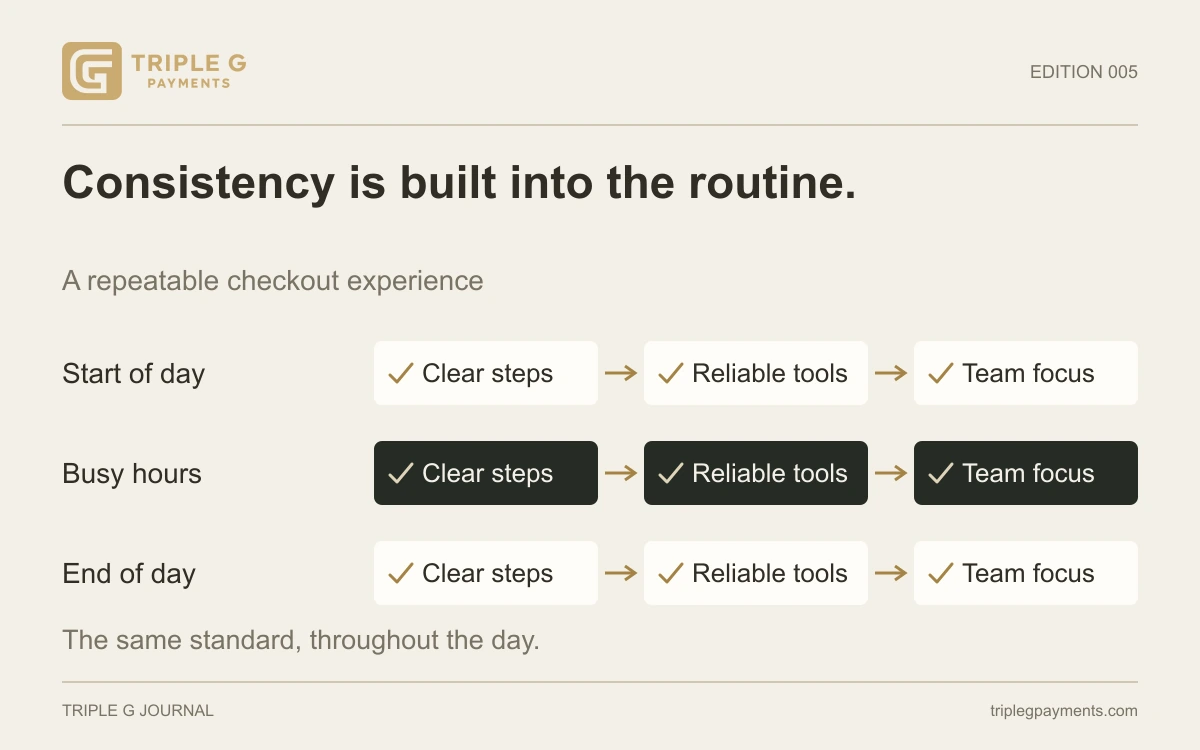
Does the system behave consistently from transaction to transaction?
Checkout design should account for repetition.
A process that works well during a demonstration may feel very different after an employee has completed it hundreds of times.
Good employee flow reduces unnecessary decisions and allows staff to focus more attention on the customer.
3. PAYMENT FLOW
A customer initiates a payment.
The payment must be accepted, authorized, and completed.
From there, additional processes eventually support settlement, funding, reporting, and reconciliation.
The terminal is the most visible part of this flow, but it is not the entire flow.
This is an important distinction.
Retailers often evaluate payment systems by what they can physically see at checkout.
Yet the quality of the payment experience depends on infrastructure operating beyond the device.
Reliability matters.
Consistency matters.
Understanding what happens when something doesn’t work matters.
Fast transactions are valuable.
A payment system that performs predictably across thousands of transactions is more valuable operationally.
Payment flow therefore connects the checkout experience to the larger payment infrastructure supporting the business.
4. INFORMATION FLOW
Every transaction creates more than a payment.
It creates information that must move through the business.
What was sold?
When did the transaction occur?
How was the payment completed?
What payment record corresponds to the sale?
What activity will eventually settle?
How will that activity appear in reporting?
How will the business reconcile it later?
Information flow determines how effectively those answers remain connected.
It links sales activity, payment records, settlement information, reporting, and reconciliation into one readable trail.
This may be the least visible component of checkout to the customer, but it can become one of the most important components for management.
It determines whether transaction data can be linked across checkout, payment records, settlement, reporting, and reconciliation.
A transaction can be completed while still creating administrative work later.
If sales activity, payment records, settlement information, and reporting are difficult to connect, employees or accounting teams may need to reconstruct the transaction manually.
The better the information flow, the easier it becomes to understand what happened from checkout through the back office.
FOUR FLOWS. ONE CHECKOUT.
The four flows are useful individually.
Their real value appears when you consider them together.
Customer Flow determines how the buyer experiences checkout.
Employee Flow determines how the staff operates it.
Payment Flow determines how the transaction moves.
Information Flow determines how the business understands what happened.
A weakness in one flow can affect another.
A payment issue can delay a customer.
A complicated employee process can slow customer flow.
Disconnected information can create manual reconciliation.
A checkout design that prioritizes transaction speed while ignoring employee workflow may shift friction elsewhere.
The objective is not to optimize one flow in isolation.
It is to make the four flows work together.
SIMPLE AT THE COUNTER DOES NOT MEAN SIMPLE BEHIND IT
Some of the best technologies feel remarkably simple. That simplicity can be misleading. What appears simple at the counter may rely on many connected systems behind it.
The real strength of checkout is not how simple it looks, but how well those systems work together.
A customer taps, inserts, or otherwise completes a payment in seconds.
Behind that moment may be multiple systems exchanging information and performing processes the customer never sees.
This is not a weakness.
It is often the point.
Strong infrastructure absorbs complexity, so users do not have to manage it themselves.
For retailers, the same principle should apply to checkout.
Customers should not have to understand payment infrastructure.
Employees should not have to compensate for disconnected systems.
Managers should not have to reconstruct transaction activity manually.
The architecture should handle complexity.
CHECKOUT FRICTION COMPOUNDS WITH VOLUME
Edition 016 introduced the Total Cost to Accept™, including the concept of friction costs.
Checkout is one of the clearest places to see those costs emerge.
Consider a small additional task required during every transaction. At low volume, it may barely be noticeable. As transaction volume grows, you repeat the same task hundreds or thousands of times. What feels minor at the counter becomes meaningful friction across the business.
Now expand across multiple employees.
Then multiple registers.
Then multiple locations.
What began as a minor inconvenience becomes part of the operating model.
This is why checkout architecture has become increasingly important as retailers scale.
Volume magnifies design decisions.
Good ones and bad ones.
MULTI-LOCATION RETAIL CHANGES THE STANDARD
One store can often operate around imperfect systems.
An experienced manager knows the workarounds.
Employees know whom to ask when something goes wrong.
Manual processes may remain manageable.
Multi-location retail changes that equation.
Processes need to become more repeatable.
Training needs to be consistent.
Payment experiences need to behave predictably.
Information needs to reach management in a form that the organization can understand.
Checkout therefore becomes more than a store-level concern.
It becomes part of enterprise infrastructure.
The question changes from:
“Does this work at the register?”
to:
“Can this work consistently across the organization?”
HOW RETAILERS SHOULD EVALUATE CHECKOUT
The physical terminal is one part of the evaluation.
The larger questions are operational.
How many steps does the customer experience?
How many steps does the employee take?
How reliably does the payment process complete?
How well do the POS and payment environment work together?
What information is created?
Where does that information go?
How is it used?
How does it support reporting, settlement, and reconciliation?
How easily can transaction activity later be connected to settlement and reporting?
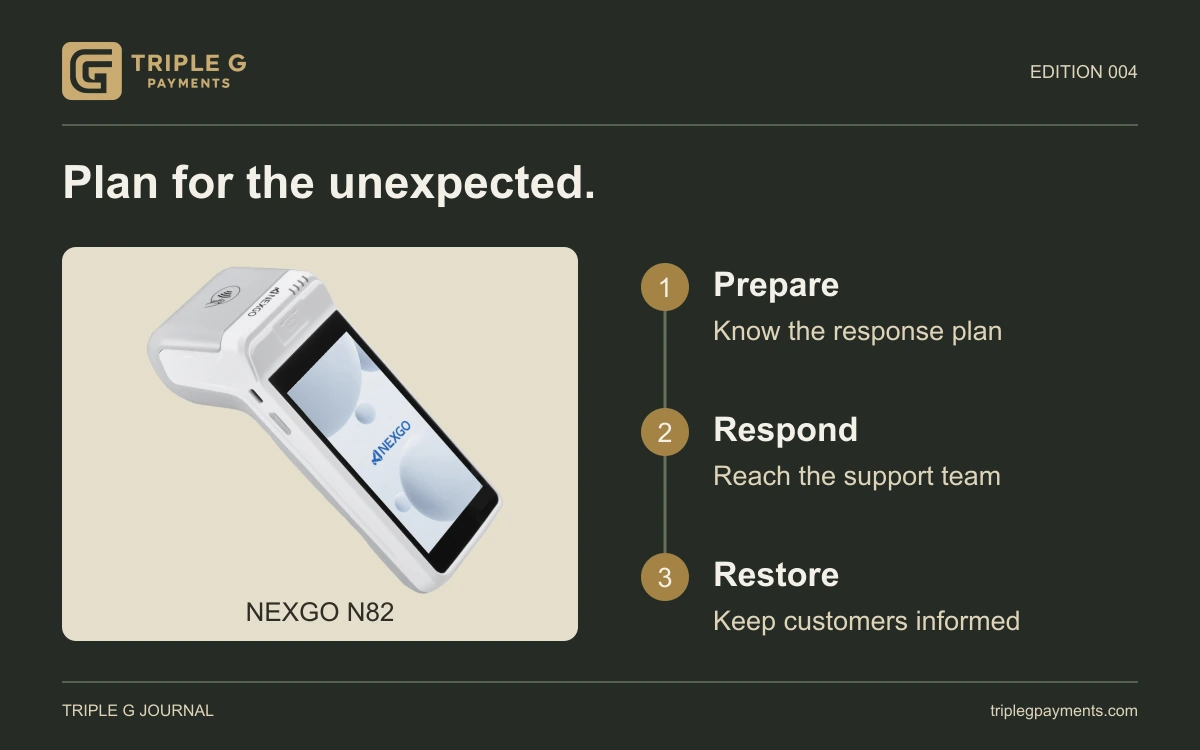
What happens when something goes wrong?
How much manual intervention does the process require?
And perhaps most importantly:
Does the checkout system reduce complexity, or move it somewhere else?
Those questions provide a more complete picture of checkout performance.
Ultimately, the best checkout systems do more than process a sale. They connect customer flow, employee flow, payment flow, and information flow into one operating system that makes the business easier to run.
FROM CHECKOUT COUNTER TO OPERATING INFRASTRUCTURE
The checkout counter has traditionally been treated as a physical place.
Increasingly, it should also be understood as a system.
It is the point where customer experience meets employee workflows.
Where the POS meets the payment infrastructure.
Where a sale becomes a payment record.
Where information begins moving toward settlement, funding, reporting, and reconciliation.
That makes checkout one of the most interconnected parts of the retail operation.
The device matters.
The connections matter more.
BUILDING ON THE PAYMENT INFRASTRUCTURE
The recent Triple G Journal frameworks describe different parts of the same system.
The Payment Lifecycle explains how a transaction moves.
The Funding Visibility Loop explains how transaction activity connects to funding and reconciliation.
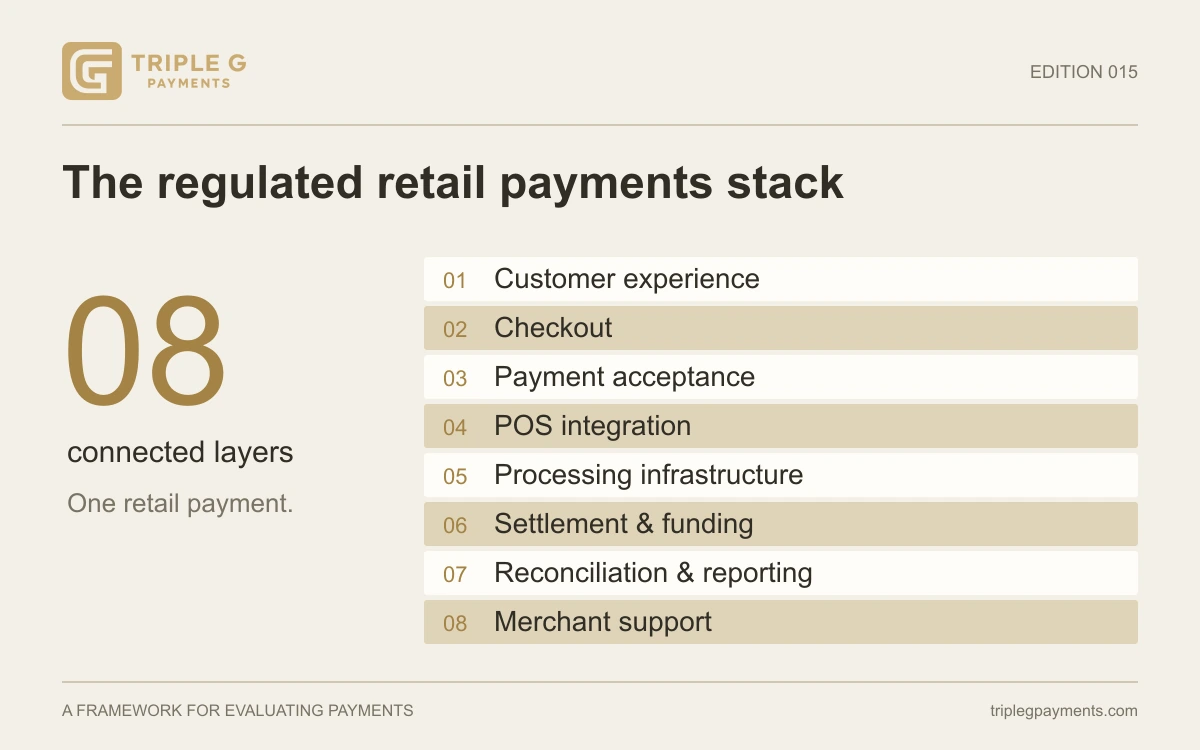
The Regulated Retail Payments Stack explains the infrastructure supporting those processes.
The Total Cost to Accept™ examines their economic impact.
Now, Checkout Architecture examines the point where much of that infrastructure meets the actual retail experience.
These are not separate ideas.
Together, they provide a more complete view of modern regulated retail payments.
THE TRIPLE G PERSPECTIVE
Checkouts should feel simple.
But achieving simplicity requires more than placing a terminal on a counter.
Customer flow needs to make sense.
Employee flow needs to be repeatable.
Payment flow needs to be dependable.
Information flow needs to remain connected after the transaction is complete.
When those four flows work together, the complexity behind checkout becomes less visible to the people using it.
That is the objective.
Because checkout is not simply where the sale ends.
It is where customer experience, employee workflow, payment infrastructure, and retail operations come together.
Moving Cannabis Commerce Forward.
- Cannabis
- Retail Operations
- Customer Experience
- Payment Infrastructure
- POS Integration
- Checkout Architecture
- Reconciliation
Review your current payment program
Put this article to work. Request a payment review and we will evaluate your current rebate, operating fees, transaction volume, and equipment needs.
Request a Payment Review
Triple G Journal publishes educational content for cannabis retail leaders, covering cannabis payments, retail operations, finance, technology, compliance, leadership, and business strategy. Every edition is written and reviewed by the Triple G Payments team.