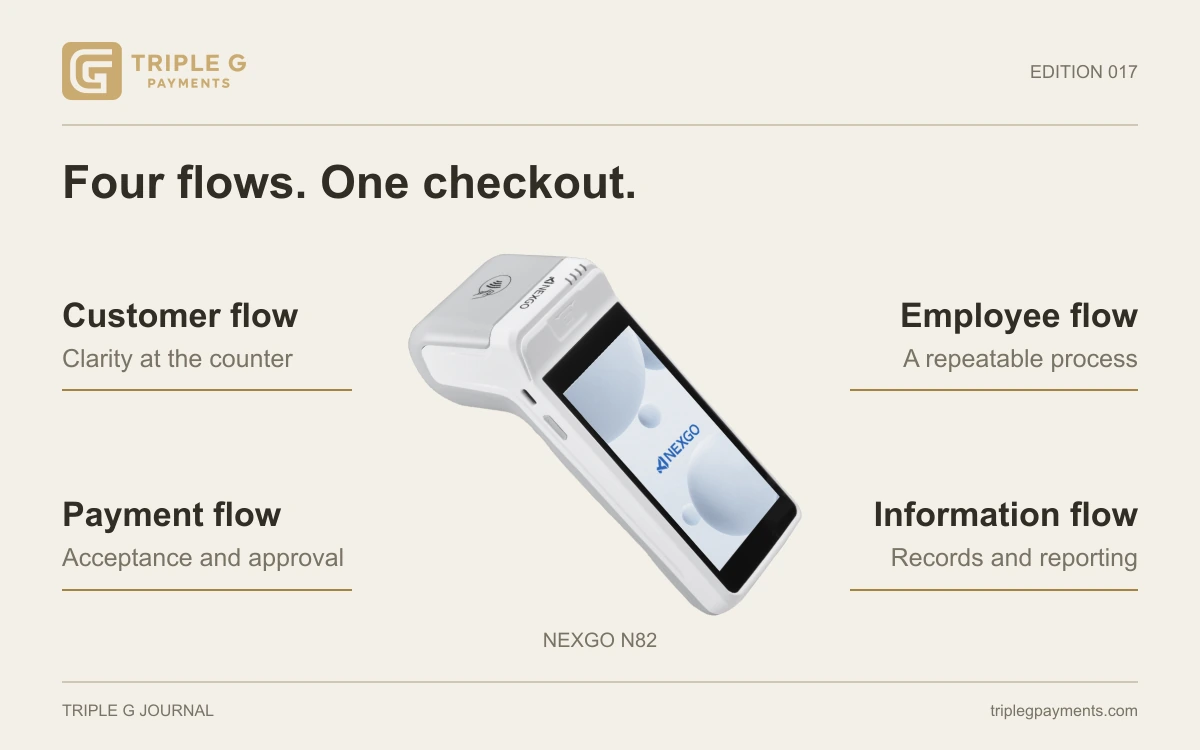
A payment terminal is only the visible edge of a much larger system. Behind every transaction are interconnected layers responsible for checkout, payment acceptance, POS connectivity, processing, funding, reporting, reconciliation, and support. Understanding those layers helps regulated retailers evaluate the infrastructure behind getting paid.
EXECUTIVE SUMMARY
When a customer approaches the checkout counter, the payment experience appears relatively simple.
The purchase is entered. A payment method is selected. The customer completes the transaction. The sale concludes.
But what seems like a single interaction is supported by a larger operating environment.
The terminal is one component.
The POS is another.
Payment acceptance, processing infrastructure, settlement, funding, reporting, reconciliation, and merchant support each play distinct roles in moving a transaction from the checkout counter into the business's financial operations.
For regulated retailers, those connections matter.
A payment environment can perform well in one area while creating unnecessary friction in another. Checkout may be simple for the customer while reporting remains difficult for management. Technology may function reliably until an issue occurs, and support responsibilities become unclear. A system that works for one store may become difficult to manage across ten. These differences show why you should view the stack layer by layer.
Looking at individual products or features can therefore provide an incomplete picture.
A better approach is to understand the entire system.
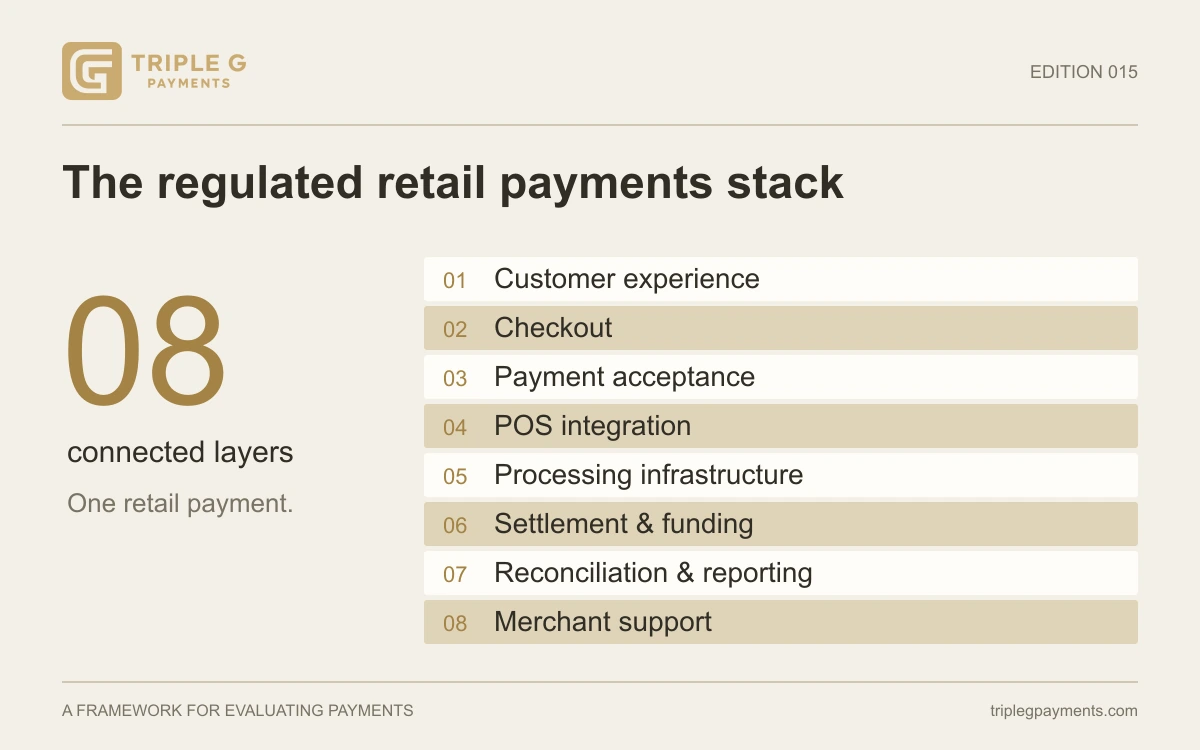
We call that system the Regulated Retail Payments Stack.
PAYMENTS ARE INFRASTRUCTURE
Payment technology is often evaluated by what retailers can physically see.
The terminal.
The checkout screen.
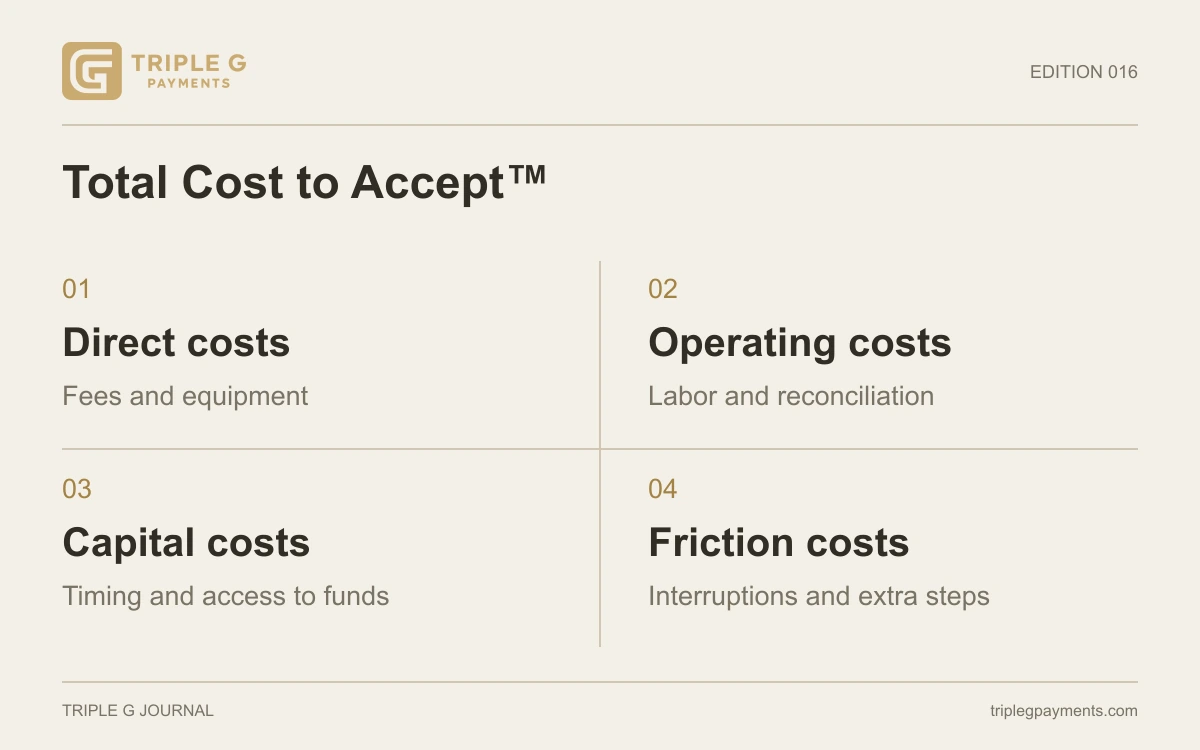
The transaction fee.
Those elements are important, but they represent only one part of the payment environment.
Behind the customer-facing transaction are systems and processes that move information and financial activity through the business.
That makes payments more than a checkout tool.
They are infrastructure.
Like most infrastructure, the strongest systems often go unnoticed when they work properly.
Employees understand the process.
Customers complete purchases without unnecessary friction.
Transaction activity is visible.
Funding follows understood expectations.
Reporting supports management.
Reconciliation can be completed efficiently.
Support is available when something does not behave as expected.
None of those outcomes depends exclusively on the terminal sitting on the counter.
They depend on the layers behind it.
THE REGULATED RETAIL PAYMENTS STACK
The Triple G Regulated Retail Payments Stack organizes payment infrastructure into eight connected layers:
Customer Experience → Checkout → Payment Acceptance → POS Integration → Processing Infrastructure → Settlement & Funding → Reconciliation & Reporting → Merchant Support
The framework is intentionally straightforward. It shows how the layers connect. Retail operators do not need to become payment engineers. They should, however, understand the major layers supporting their payment environment and how those layers differ and interact.
A weakness in one layer can create friction in another.
A strong stack should make those connections easier to understand and manage.
1. CUSTOMER EXPERIENCE
The first layer begins with the person making the purchase.
Customers generally do not think about payment infrastructure.
They experience the result of it.
Was the payment process easy to understand?
Did the transaction complete without unnecessary delay?
Did the checkout experience feel consistent with the rest of the store?
Payments are one of the final interactions a customer has with a retailer before leaving.
That makes the payment experience part of the broader customer experience.
A retailer can invest heavily in store design, product selection, employee training, and customer service, only to create friction at the final moments of the purchase.
The technology underneath the transaction may be complex.
The customer experience should not feel that way.
2. CHECKOUT
The second layer is the operating environment surrounding the transaction.
Checkout involves more than the customer.
Employees interact with the process repeatedly throughout every shift.
They need to understand how a transaction begins, what happens during payment, how the sale is completed, and what to do when something does not proceed normally.
Every additional manual step creates another opportunity for inconsistency.
At low transaction volume, small inefficiencies may be manageable.
At higher volume, repeated friction compounds.
That is why you should evaluate checkouts from both sides of the counter.
The customer needs simplicity.
The employee needs consistency.
A strong checkout environment supports both.
3. PAYMENT ACCEPTANCE
Payment acceptance is the layer where the customer completes the financial portion of the purchase.
This is often the layer retailers associate most directly with a payment provider.
But simply accepting a transaction does not answer every operational question.
Retailers should understand which payment methods are supported, how transactions are initiated, what employees and customers experience, how exceptions are handled, and how payment activity connects to the rest of the retail workflow.
In regulated industries, payment acceptance also exists within a changing environment of financial, network, compliance, and provider requirements.
That makes clarity especially important.
The question is not simply:
Can we accept payments?
It is:
How does accepting that payment fit into the rest of our operation?
4. POS INTEGRATION
The point-of-sale system sits at the center of many retail operations.
It may connect sales activity with inventory, customer information, employee workflows, reporting, and other operational functions.
Payments exist alongside that environment.
The more closely those systems operate within a coherent workflow, the less unnecessary manual work employees and managers may have to do.
This does not mean every system must be identical, or every technology must come from one company.
It means the connections should be understood.
How does a payment relate to the sale recorded in the POS?
What information moves between systems?
What must employees enter manually?
What happens if the systems do not align?
How does management investigate a difference later?
Integration should ultimately reduce operational friction rather than create another layer of complexity.
5. PROCESSING INFRASTRUCTURE
Once a transaction is initiated, activity moves beyond the checkout counter.
The processing infrastructure supports the handling of the transaction according to the applicable payment arrangement.
This is one of the least visible layers to the customer and often to store employees.
Yet it is essential.
The customer sees approval or decline.
The retailer experiences the reliability of the infrastructure behind that result.
Operators do not need to understand every technical connection involved in processing a transaction.
They should understand the practical outcomes.
Is transaction activity reliable?
Is the process understandable?
What happens when a transaction does not behave as expected?
Where does responsibility sit when an issue occurs?
Invisible infrastructure still affects visible operations.
6. SETTLEMENT & FUNDING
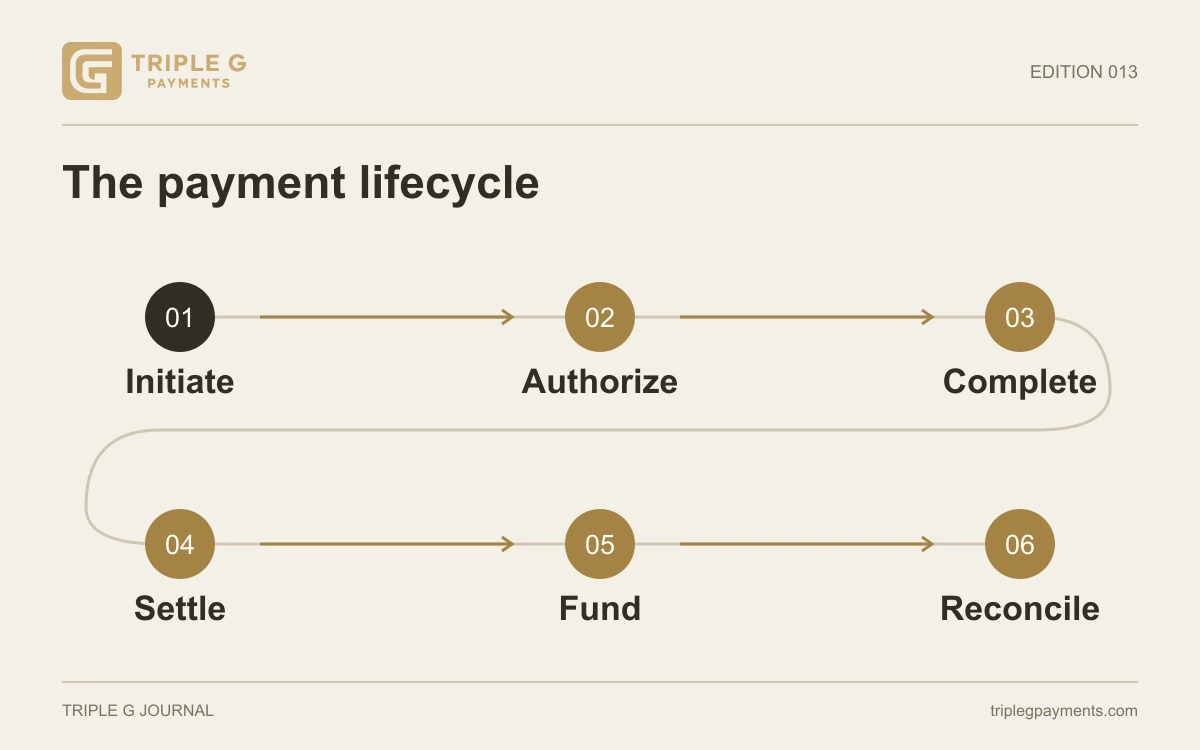
Edition 014 explores what happens after a customer pays.
That process becomes the sixth layer of the stack.
Completed transaction activity still needs to move through the applicable settlement and funding process before the retailer has a complete picture of the financial activity.
The exact mechanics and timing vary by payment method, provider, financial institutions, and merchant arrangement.
For retailers, the objective is visibility.
Management should understand when funds are expected, what can affect timing, and where to review funding activity.
This connects payments directly with the broader financial operation.
Inventory, payroll, vendor obligations, operating expenses, and growth initiatives all require capital.
Predictable funding helps leadership understand when transaction activity becomes available as business funds.
7. RECONCILIATION & REPORTING
Receiving funds does not complete the operational story.
Retailers still need to understand the source of funds and how those funds connect to recorded sales. Depending on the operating environment, management may compare payment activity with POS records, funding records, banking activity, and accounting system records.
When those records align clearly, reconciliation can become routine.
When they do not, someone must investigate.
At one location, occasional manual work may be manageable.
Across a growing organization, repeated reconciliation friction can consume meaningful administrative time.
The objective is not simply to generate more reports.
It is to make the information useful.
8. MERCHANT SUPPORT
The final layer is sometimes overlooked until something goes wrong.
Technology will not eliminate every question, exception, hardware issue, funding concern, or operational problem.
That makes support part of the infrastructure.
Retailers should understand who they contact when an issue occurs, what information is available to investigate it, how responsibilities are divided between technology partners, and what the escalation process looks like when a problem cannot be resolved immediately.
Support becomes particularly important when multiple systems interact.
A checkout issue may involve hardware.
A reporting question may involve payment data.
A workflow problem may involve the POS.
A funding question may occur after the transaction has already left the store.
When responsibilities are unclear, the merchant can end up coordinating between multiple companies.
Strong infrastructure should make the path toward resolution easier to understand.
THE CONNECTIONS BETWEEN LAYERS MATTER
The individual layers are important.
The connections between them may matter even more.
Consider a transaction that completes successfully for the customer but requires an employee to correct information afterward manually.
The customer experience may have worked.
The operational workflow did not work.
Or consider a payment environment that provides predictable funding but makes it difficult for management to determine which transaction activity corresponds with a particular deposit.
Funding worked.
Financial visibility did not.
A retailer can therefore have strong individual components and still experience a weak overall system.
That is why evaluating the stack requires looking horizontally across the business, not only vertically at individual products.
SCALE CHANGES THE STANDARD
Infrastructure becomes more important as scale grows.
At one location, employees can sometimes compensate for disconnected systems through communication and manual work.
Someone remembers how to resolve an issue.
A manager compares two reports manually.
An employee enters information into multiple systems.
A funding question is handled by phone.
These processes may appear acceptable because the organization is still small enough for people to bridge the gaps.
Growth changes that.
Ten locations can mean more employees, devices, transactions, reports, managers, funding activity, permissions, training requirements, and support requests.
Manual knowledge becomes harder to distribute.
Inconsistency becomes harder to identify.
Small inefficiencies become repeated processes.
Infrastructure that seemed adequate at one store can begin revealing its limitations.
HOW RETAILERS SHOULD EVALUATE THE STACK
A payment decision should not begin and end with a single feature or rate.
Operators can evaluate the system layer by layer.
What will customers experience?
What will employees experience?
How does checkout work?
How is payment activity accepted?
How does the payment environment interact with the POS?
What infrastructure supports the transaction?
How do settlement and funding work?
What reporting is available?
How will the business reconcile activity?
Who provides support when something goes wrong?
The answers create a much more complete picture than evaluating one piece of equipment or one pricing number in isolation.
THE STACK SHOULD REDUCE COMPLEXITY, NOT MOVE IT
Retail technology can sometimes look simple because complexity has been moved elsewhere.
A process may look easy at checkout but create additional work in the back office.
A system may automate one task while requiring another task to be completed manually.
A reporting tool may provide more information without making that information easier to understand.
Infrastructure should not hide complexity from one part of the organization by shifting it to another.
It should reduce unnecessary complexity across the operation.
That is an important distinction.
The best system is not necessarily the one with the most features.
It is the one whose components work together in a way the organization can understand, operate, and scale.
FROM PAYMENT PRODUCT TO PAYMENT SYSTEM
The shift from viewing payments as a product to viewing them as a system changes the questions retailers ask.
Instead of:
What terminal do we get?
The question becomes:
How does the payment environment fit into our checkout operation?
Instead of:
What is the processing cost?
The question becomes:
What is the complete operational and financial impact of accepting payments this way?
Instead of:
How quickly do we get funded?
The question becomes:
How predictable and visible is the entire process from transaction to reconciliation?
Those are infrastructure questions.
And as regulated retail becomes more sophisticated, infrastructure questions become increasingly important.
THE BIGGER PICTURE
Modern cannabis retail is becoming more operationally complex.
Stores are becoming more sophisticated.
Retail groups are expanding.
Technology environments are becoming more connected.
Leadership teams are demanding greater visibility.
Customers expect checkout to stay simple, no matter what happens behind the scenes.
Payments sit directly inside that evolution.
They connect the customer experience with employees, retail technology, financial activity, reporting, and management.
That is why payment infrastructure deserves to be evaluated as a complete system.
Not simply as a device.
Not simply as a transaction.
Not simply as a rate.
As a stack.
THE TRIPLE G PERSPECTIVE
The payment terminal may be where the customer sees the transaction.
It is not where the payment system begins or ends.
Behind that moment are layers responsible for customer experience, checkout, acceptance, POS connectivity, processing, settlement, funding, reporting, reconciliation, and support.
Each layer serves a different purpose.
Each connection affects the broader operation.
And as retailers grow, the quality of those connections becomes increasingly important.
The Regulated Retail Payments Stack gives operators a framework to look beyond individual products and evaluate the infrastructure behind getting paid.
Strong payment infrastructure isn't defined by one impressive component.
It is defined by how well the entire stack works together.
Triple G Journal explores the payment infrastructure, economics, operational systems, and strategic decisions shaping modern cannabis retail.
Moving Cannabis Commerce Forward.
- Cannabis
- Payment Infrastructure
- Payment Processing
- Retail Operations
- POS Integration
- Settlement
- Merchant Funding
- Reconciliation
- Merchant Support
Review your current payment program
Put this article to work. Request a payment review and we will evaluate your current rebate, operating fees, transaction volume, and equipment needs.
Request a Payment Review
Triple G Journal publishes educational content for cannabis retail leaders, covering cannabis payments, retail operations, finance, technology, compliance, leadership, and business strategy. Every edition is written and reviewed by the Triple G Payments team.