Businesses tend to celebrate revenue above everything else.
Companies announce sales targets at meetings. Monthly revenue reports become scorecards. Growth charts appear in presentations, and people often measure successful months with one simple question.
“How much did we sell?”
Revenue deserves that attention.
Without customers, there is no business. Every dollar earned represents trust, demand, and the ability to continue moving forward.
But experienced operators understand something that newer businesses often learn the hard way.
Revenue and financial strength are not the same thing.
Two companies can finish the month with identical sales numbers while facing entirely different futures.
One business ends the month planning to hire another employee, expand inventory, and invest in new opportunities.
The other delays purchases, postpones growth initiatives, and carefully watches every dollar leaving the bank account.
Their revenue is identical.
Their financial position is not.
The difference is cash flow.
Accountants, financial advisors, and lenders often discuss cash flow, yet it deserves far more attention in day-to-day business operations. It determines whether revenue becomes an opportunity or simply another number on a report.
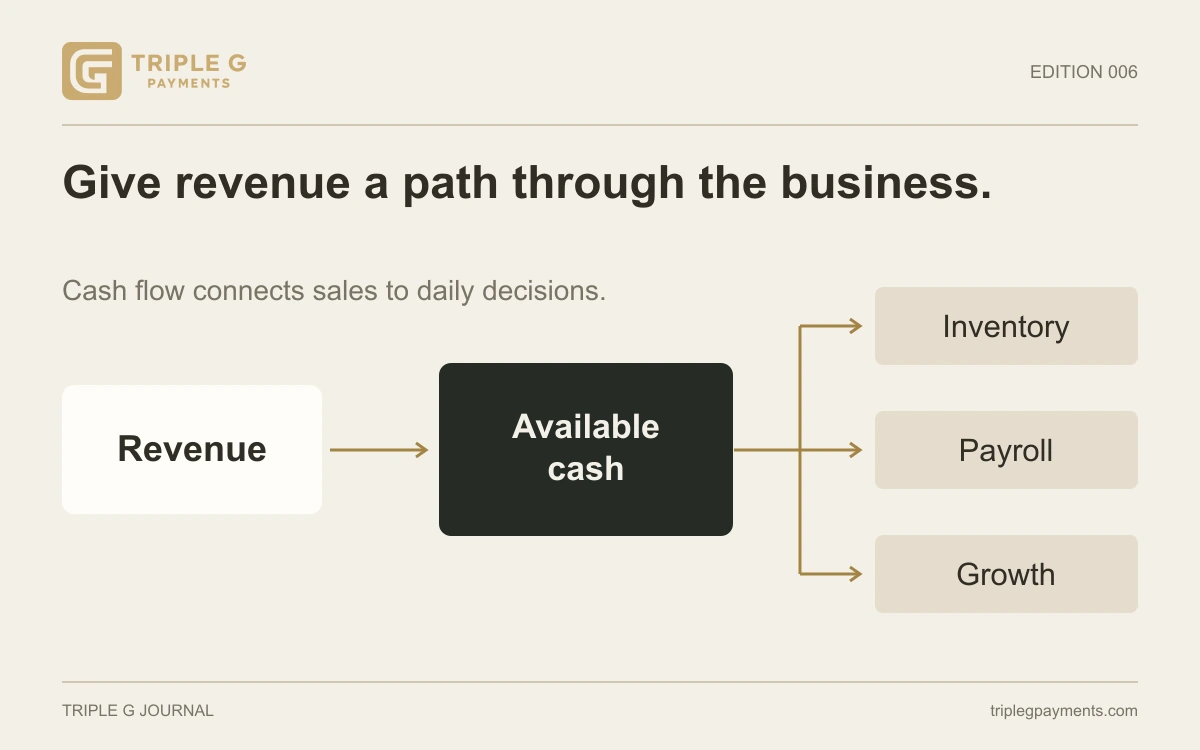
For retailers, cash flow influences nearly every operational decision.
Can inventory be replenished before products run out?
Can payroll be met comfortably every pay period?
Can you upgrade equipment when it needs to be replaced?
Can the business confidently invest in marketing, additional staff, or a second location?
These decisions are rarely limited by revenue alone.
They are limited by available cash.
That distinction matters more as businesses grow.
Growth often creates larger expenses before it creates larger profits. Additional employees, expanded inventory, new locations, and operational investments all require capital long before they begin generating additional revenue.
Businesses with healthy cash flow can make those investments confidently.
Businesses without it often find themselves reacting to financial pressure, even while generating impressive sales.
That is why successful operators pay close attention not only to how much money the business earns, but also to how efficiently that money moves through the organization.
Revenue measures activity.
Cash flow measures flexibility.
One reflects what happened.
The other determines what happens next.
Looking Beyond the Income Statement
Financial reports provide valuable information, but they rarely tell the entire story.
Revenue explains how much business was generated.
Profit explains what remains after expenses.
Cash flow explains whether the business has the resources available to continue operating effectively tomorrow.
Those are three very different conversations.
Imagine two retailers reporting identical monthly revenue.
One receives deposits consistently, manages inventory efficiently, and maintains predictable operating capital. Leadership spends its time planning for future growth because the business has confidence in its financial position.
The second retailer experiences inconsistent cash availability, delayed operational decisions, and constant pressure surrounding short-term obligations. Revenue may continue growing, but leadership spends far more time managing immediate concerns than preparing for future opportunities.
On paper, both businesses appear successful.
Operationally, they could not be more different.
That is why experienced business leaders rarely evaluate financial performance through a single metric.
They understand that healthy cash flow gives every growing organization something it depends on.
Options.
Options to invest.
Options to hire.
Options to improve.
Options to continue growing without unnecessary financial pressure.
Cash flow is not simply about money moving through a business.
It is about creating the confidence to make better decisions.
Operational Efficiency Drives Financial Performance
Many business owners believe stronger financial performance begins by increasing sales.
Sometimes it does.
More often, it begins by improving the systems that support those sales.
Operational efficiency determines how effectively you convert revenue into working capital.
Reliable payment processing.
Predictable funding.
Disciplined expense management.
Efficient inventory planning.
Clear operational procedures.
None of these systems directly increase revenue.
Together, they strengthen the business's financial health.
Every unnecessary delay creates friction.
Every inefficient process slows momentum.
Every operational improvement helps revenue move through the organization more effectively.
The strongest businesses understand that financial performance rarely comes from one dramatic decision.
It is built through dozens of operational decisions executed consistently over time.
Cash Flow Creates Strategic Freedom
One of the greatest advantages healthy cash flow provides is freedom.
Freedom to make decisions based on opportunity instead of urgency.
Businesses with consistent access to working capital rarely face reactive choices. They can buy inventory before shortages occur, not after shelves begin to empty. They can replace aging equipment before it becomes a larger operational problem. They can invest in employees, marketing, and technology because the financial resources are already available.
That flexibility creates momentum.
Leaders spend less time asking, “Can we afford to do this?” and more time asking, “Is this the right decision for the business?”
Those are two very different conversations.
Cash flow transforms financial management from a daily concern into a strategic advantage.
It allows businesses to think months ahead rather than simply making it through the week.
For growing retailers, that shift often becomes a defining difference between businesses that keep expanding and those that struggle to maintain momentum.
Small Operational Improvements Create Stronger Financial Results
Healthy cash flow rarely comes from one breakthrough.
More often, it comes from disciplined operational execution repeated every day.
Inventory is managed carefully.
Expenses are monitored consistently.
Internal processes reduce unnecessary delays.
Payment systems perform reliably.
Funds become available predictably.
Each improvement may appear relatively small on its own.
Together, they create a business that operates more efficiently, with stronger financial discipline and far less uncertainty.
The strongest operators understand that improving financial performance does not always require generating dramatically more revenue.
Sometimes the greatest opportunity already exists inside the business.
Improving operational efficiency often unlocks value that was previously hidden behind unnecessary complexity, delayed decision-making, or inconsistent financial processes.
Revenue grows the business.
Operational discipline strengthens it.
The organizations that consistently improve both rarely find themselves choosing between growth and stability.
They achieve both.
The Triple G Perspective
Businesses often measure success by the numbers that receive the most attention.
Revenue.
Sales growth.
Transaction volume.
Those measurements are important, but they represent only part of the picture.
At Triple G Payments, we believe operational strength ultimately shows up in a business’s ability to turn revenue into long-term financial stability consistently.
Healthy cash flow provides more than available capital.
It provides confidence.
Confidence to invest.
Confidence to hire.
Confidence to improve.
Confidence to continue building for the future rather than constantly responding to the present.
The strongest payment infrastructure supports that objective by helping businesses move revenue efficiently, predictably, and reliably throughout their operation.
Payment processing should never become a barrier between earning revenue and using it to grow the business.
It should become one of the systems that quietly supports every stage of that journey.
That belief continues to shape Triple G Journal.
Every edition is written to help cannabis retailers think beyond individual transactions and better understand the operational decisions that create stronger businesses over the long term.
Conclusion
Revenue will always be one of the most important measurements inside any business.
It reflects demand, customer confidence, and the ability to create opportunity.
But opportunity alone does not create lasting success.
Businesses grow strongest when healthy cash flow, disciplined operations, and thoughtful financial management support revenue.
Those principles create resilience during uncertainty and flexibility during periods of growth.
They allow leaders to invest confidently rather than react cautiously.
As the cannabis industry continues to mature, financial discipline will matter as much as sales performance.
Businesses that understand the relationship between revenue and cash flow will be better positioned to expand, navigate challenges, and keep investing in the customer experience that drives long-term success.
Because revenue may solve today’s problems.
Cash flow prevents tomorrow’s problems.
- Cannabis
- Business Strategy
- Cash Flow
- Revenue
- Financial Operations
- Operational Excellence
- Working Capital
- Retail Operations
- Business Growth
- Leadership
Review your current payment program
Put this article to work. Request a payment review and we will evaluate your current rebate, operating fees, transaction volume, and equipment needs.
Request a Payment Review
Triple G Journal publishes educational content for cannabis retail leaders, covering cannabis payments, retail operations, finance, technology, compliance, leadership, and business strategy. Every edition is written and reviewed by the Triple G Payments team.