Businesses often assume they can solve every problem with more money.
Need additional staff? Hire more people.
Need faster growth? Increase the marketing budget.
Need better technology? Invest in new software.
Capital certainly creates opportunity. Every successful business requires financial resources to grow, invest, and compete.
But every business receives one resource in the same amount.
Time.
Every owner, manager, employee, and competitor begins the day with the same twenty-four hours.
The businesses that consistently outperform the market are rarely the ones with the largest budgets. More often, they use those hours more intentionally.
That difference compounds.
Every unnecessary meeting.
Every manual process.
Every system that doesn’t communicate with another.
Every avoidable interruption.
Every minute spent solving problems that could have been prevented.
Individually, those moments appear insignificant.
Collectively, they become one of the highest hidden costs inside an operation.
The strongest retailers understand something that isn’t always reflected on a financial statement.
Protecting time is protecting profit.
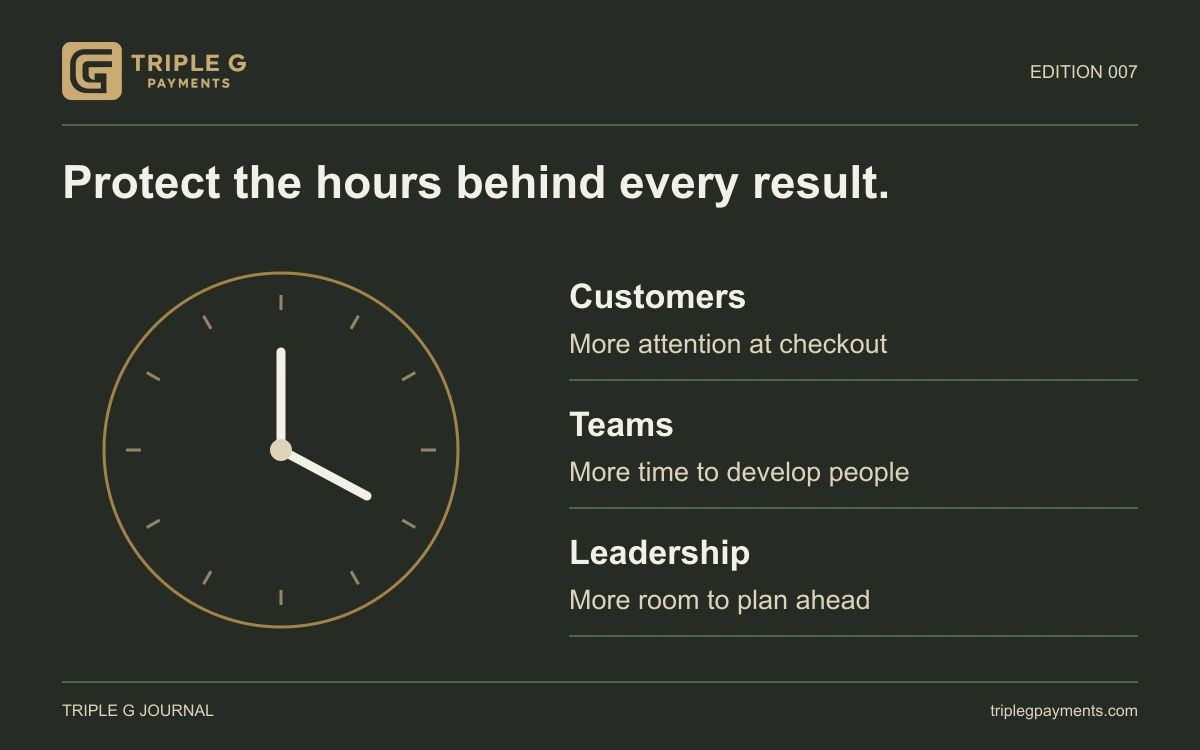
When you remove operational friction, employees spend more time serving customers instead of troubleshooting technology. Managers spend more time coaching their teams instead of resolving preventable issues. Owners spend more time building the business instead of constantly reacting to it.
Time creates capacity.
Capacity creates growth.
That is why operational excellence should never be measured only by dollars saved.
It should also be measured by hours returned.
Time Is Your Only Non-Renewable Asset
Money can be earned again.
Inventory can be reordered.
Equipment can be replaced.
Marketing campaigns can be restarted.
Time cannot.
Once an hour has passed, it is gone forever.
That reality changes the way exceptional operators make decisions.
Instead of asking whether a process works, they ask whether it works efficiently.
Instead of accepting unnecessary delays as part of the business, they look for opportunities to eliminate them.
Instead of measuring only financial return, they consider the return on time.
The businesses that create the greatest long-term value recognize that every operational decision either gives time back or quietly takes it away.
Small Interruptions Become Expensive Problems
Very few businesses lose productivity because of one catastrophic event.
Most lose it through hundreds of small interruptions that repeat every day.
A checkout that takes longer than necessary.
A payment issue requiring manual intervention.
Employees waiting for approvals.
Managers searching for information across multiple systems.
Customers standing in line while staff resolves avoidable operational problems.
Each interruption may consume only a few minutes.
Multiply those minutes across employees, customers, and every day of the year, and the cost becomes substantial.
These hidden losses rarely appear on a profit and loss statement.
Yet they influence productivity, customer satisfaction, employee morale, and ultimately profitability.
Operational friction is expensive precisely because it often goes unnoticed.
Great Systems Create More Time
One defining characteristic of exceptional businesses is that their systems quietly support the people using them.
Employees should spend their day helping customers.
Not navigating unnecessary complexity.
Technology should simplify work.
Not create additional work.
Reliable operational systems remove repetitive tasks, reduce uncertainty, and create consistency throughout the organization.
When processes become predictable, teams become more confident.
When technology becomes dependable, employees spend less time troubleshooting and more time creating value.
The goal of operational improvement is not simply to increase speed.
It is to remove unnecessary effort.
That distinction matters.
Working faster in an inefficient system produces inefficient results faster.
Improving the system itself changes the outcome for everyone.
Time Creates Better Leadership
Owners often believe they need more hours.
In reality, they usually need fewer distractions.
Leadership requires uninterrupted time to think strategically.
Planning growth.
Developing employees.
Building relationships.
Improving operations.
Exploring new opportunities.
Those responsibilities are frequently pushed aside because daily operational issues constantly demand attention.
The strongest businesses reduce those interruptions before they occur.
As operational consistency improves, leadership shifts from reacting to problems toward creating long-term value.
That transition becomes one of the clearest indicators of a maturing organization.
Businesses grow when leaders have the time to lead.
The Bigger Picture
Businesses become more valuable when they consistently convert time into meaningful progress.
That happens through intentional systems, dependable technology, disciplined processes, and a culture focused on continuous improvement.
The objective isn’t simply to complete more tasks.
It is to ensure that every hour invested creates the greatest possible return.
Organizations that protect time create better customer experiences.
They develop stronger employees.
They improve decision-making.
They reduce unnecessary costs.
Most importantly, they create the capacity required for sustainable growth.
Time is not simply another business resource.
It is the resource from which every other result is produced.
THE TRIPLE G PERSPECTIVE
The strongest businesses don’t simply maximize revenue.
They maximize attention.
When leaders spend less time solving preventable problems, they gain more time to improve operations, develop employees, strengthen customer relationships, and plan for the future.
Operational excellence isn’t built through one breakthrough. It comes from hundreds of small decisions that remove friction, improve consistency, and protect the most valuable resource every business has.
Time.
Businesses that intentionally protect time build stronger teams, create better customer experiences, and make better decisions because they aren’t constantly operating in reaction mode.
Revenue will always matter.
Profit will always matter.
But neither exists without the hours required to earn them.
Businesses that continue to outperform year after year recognize that time isn’t simply another expense to manage. It is the foundation that supports every other investment.
Protect your team’s time.
Design systems that eliminate unnecessary work.
Remove obstacles before they become daily frustrations.
The greatest competitive advantage often isn’t having more resources than everyone else.
It’s using the ones every business already has better.
Review your current payment program
Put this article to work. Request a payment review and we will evaluate your current rebate, operating fees, transaction volume, and equipment needs.
Request a Payment Review
Triple G Journal publishes educational content for cannabis retail leaders, covering cannabis payments, retail operations, finance, technology, compliance, leadership, and business strategy. Every edition is written and reviewed by the Triple G Payments team.