Every conversation about payment processing eventually comes down to the same question.
“What’s the rate?”
It’s a reasonable place to start.
Processing fees are measurable, easy to compare, and directly affect operating expenses. Retailers should absolutely understand what they’re paying and why.
But focusing only on the processing rate can create a costly blind spot.
Many expenses that most affect a retail business never appear on a monthly processing statement. They show up as lost sales, operational disruptions, frustrated employees, and customers who leave with a less-than-exceptional experience.
These costs are difficult to measure because they rarely arrive as a single invoice.
Instead, they accumulate quietly over weeks, months, and years.
A checkout interruption during a busy afternoon.
An employee spending valuable time troubleshooting equipment instead of helping customers.
A manager abandoning operational priorities to resolve another payment issue.
A customer who decides not to return after experiencing unnecessary friction at checkout.
Individually, these moments may seem insignificant.
Collectively, they become some of the most expensive operational problems a retailer can face.
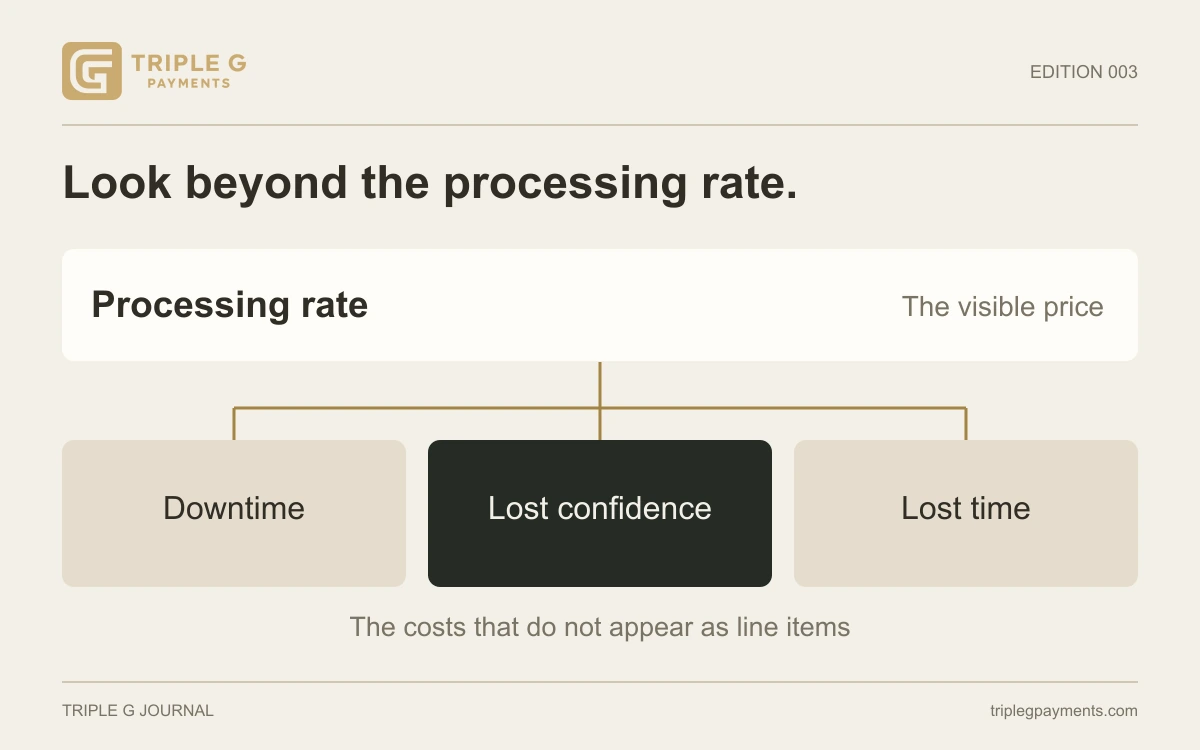
That is why the true cost of a payment system extends far beyond the processing rate.
Evaluate it by how effectively it supports the business every day.
Downtime Costs More Than Revenue
When a payment system becomes unavailable, the immediate concern is usually lost transactions.
While that financial impact is real, it is often only the beginning.
Checkout lines begin to grow.
Employees become distracted as they attempt to troubleshoot the issue while continuing to serve customers.
Managers leave other responsibilities to resolve the problem.
Customers who expected a quick, professional experience suddenly find themselves waiting without clear answers.
The disruption spreads throughout the operation.
What began as a technical issue quickly becomes a customer service issue, an employee productivity issue, and a management issue.
Even brief interruptions can have lasting effects if they occur during peak business hours.
Reliable payment infrastructure is valuable because it prevents these disruptions before they affect the rest of the operation.
The Hidden Cost of Lost Confidence
Customers expect checkout to feel effortless.
They rarely think about the payment process when everything works as expected.
They immediately notice when it doesn’t.
An uncertain payment experience creates hesitation during the final interaction of the customer journey. Whether the issue lasts thirty seconds or several minutes, that uncertainty can influence how customers remember the business as a whole.
Trust is built through consistency.
Every successful transaction quietly reinforces confidence.
Every unnecessary interruption begins to erode it.
For retailers, protecting customer confidence is every bit as important as protecting revenue.
Time Is an Operational Asset
One of the most valuable resources inside any business is time.
Every minute spent resolving payment issues is a minute you can’t invest elsewhere.
Employees lose opportunities to serve customers.
Managers lose time they could spend coaching their teams, improving operations, or planning for growth.
Operational momentum slows as attention shifts from running the business to fixing preventable problems.
Those hidden costs rarely appear on financial reports.
You feel them in lower productivity, increased frustration, and missed opportunities throughout the day.
The strongest payment systems do more than process transactions.
They give businesses their time back.
The Bigger Picture
Processing rates deserve attention.
They affect operating costs and should always be understood before you decide.
But the strongest retail operations recognize that payment processing is not simply a financial service.
It is part of the operational infrastructure that supports the entire business.
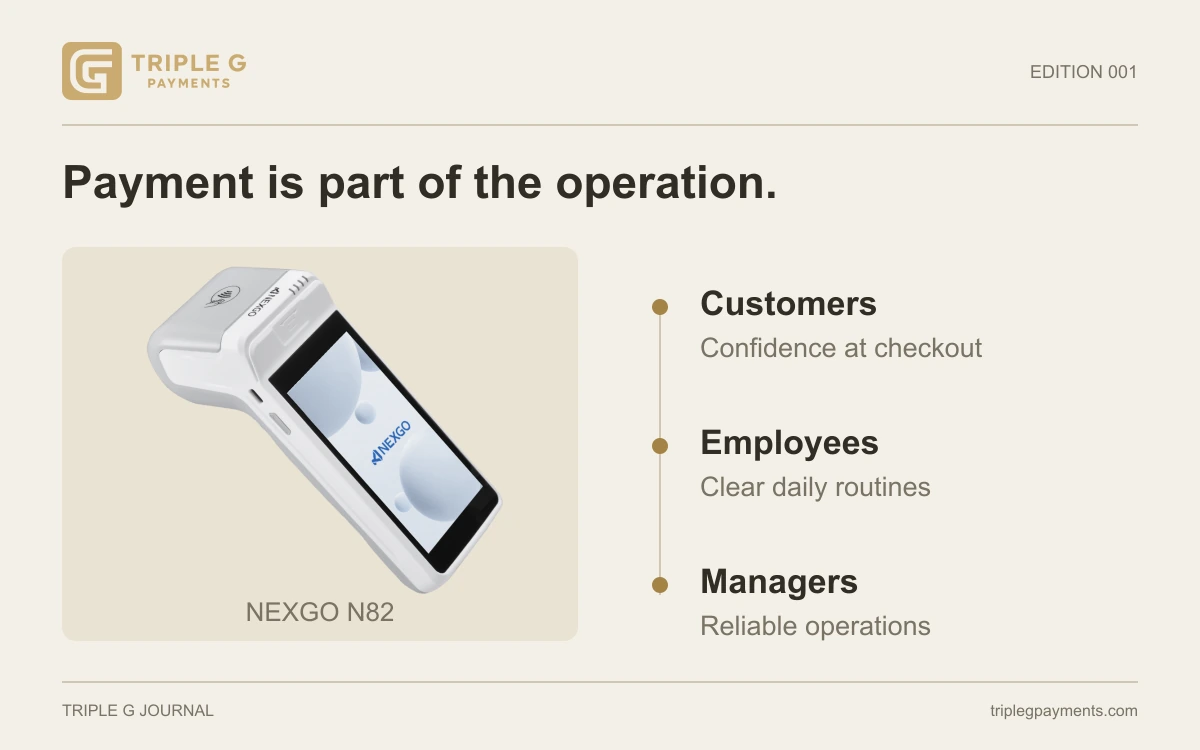
The right payment solution keeps employees focused on customers instead of troubleshooting equipment. It allows managers to spend their time improving operations rather than responding to preventable disruptions. It creates a checkout experience that feels professional, consistent, and dependable every single day.
Those advantages are difficult to assign a dollar value.
Yet they often create more long-term value than saving a fraction of a percentage point on processing costs.
Businesses that evaluate payment systems solely by price risk overlooking the qualities that contribute most to operational excellence.
The best investment is not always the cheapest option.
It is the one that helps the business operate better tomorrow than it does today.
The Triple G Perspective
When businesses compare payment providers, conversations often begin with cost.
They should begin with continuity.
The most valuable payment systems are rarely the ones that advertise the lowest processing rates. They quietly support the business every day without demanding attention. They allow employees to remain focused on serving customers, managers to focus on leading their teams, and owners to focus on growing the business rather than solving operational problems.
In many ways, the best payment system is the one customers never notice.
Transactions happen quickly.
Checkout feels effortless.
Operations continue without interruption.
Success isn’t measured only by what appears on a monthly processing statement.
It is measured by the disruptions that never occur, the time that is never lost, and the confidence customers have every time they complete a purchase.
That philosophy is what continues to guide Triple G Journal.
Every edition is written with one objective in mind: helping cannabis retailers make stronger operational decisions by looking beyond the obvious metrics and focusing on what creates lasting business value.
Conclusion
Processing rates will always be part of the conversation.
They should never be the entire conversation.
The true cost of a payment system is reflected in its ability to support employees, strengthen customer confidence, reduce operational interruptions, and provide the consistency every successful retailer depends on.
When payment infrastructure works exactly as it should, businesses rarely think about it.
That is precisely the point.
Reliable systems free you to focus on serving customers, developing employees, and growing the business instead of reacting to preventable issues.
As the cannabis industry continues to mature, retailers who evaluate payment providers through the lens of operational excellence—not simply price—will be better positioned to deliver consistent customer experiences and build stronger businesses over the long term.
Because the most expensive payment problems are rarely found on a monthly statement.
They’re found in the opportunities a business loses when its systems fail to support the people who rely on them every day.
- Cannabis
- Cannabis Payments
- Payment Processing
- Merchant Services
- Retail Operations
- Business Operations
- Operational Excellence
- Customer Experience
- Dispensary
- Business Strategy
Review your current payment program
Put this article to work. Request a payment review and we will evaluate your current rebate, operating fees, transaction volume, and equipment needs.
Request a Payment Review
Triple G Journal publishes educational content for cannabis retail leaders, covering cannabis payments, retail operations, finance, technology, compliance, leadership, and business strategy. Every edition is written and reviewed by the Triple G Payments team.